


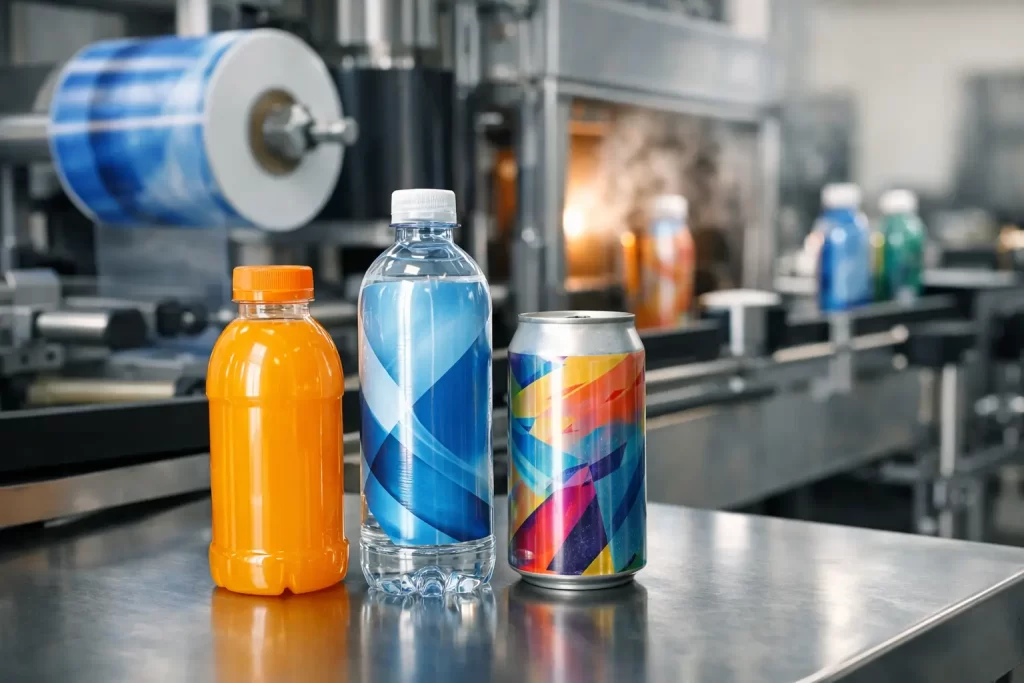
A package gets only a few seconds to win attention on the shelf. In that moment, shape, color, finish, and readability all compete at once. That is why shrink sleeve label printing has become a serious packaging decision for brands that need more than a standard front-and-back label.
For many product categories, shrink sleeves solve two problems at the same time. They create strong visual impact with full-body decoration, and they perform well on containers that are curved, contoured, or otherwise difficult to label with conventional methods. For procurement teams and packaging managers, the value is not just aesthetic. It is operational, commercial, and often regulatory.
What shrink sleeve label printing actually does
Shrink sleeve label printing is the process of printing graphics on a heat-sensitive film that is later formed into a sleeve and applied over a container. Once heat is applied, the sleeve shrinks tightly to the shape of the package.
That basic function opens up a wide design area. Unlike pressure-sensitive labels, which usually occupy a limited panel, shrink sleeves can cover nearly the entire container. This gives brands 360-degree printable space for branding, product information, promotional messaging, and compliance text.
The result is a package that looks integrated rather than labeled. On crowded retail shelves, that difference matters. In categories such as beverages, home care, personal care, nutraceuticals, and food, visual continuity can strengthen brand recognition and improve perceived product quality.
Why brands choose shrink sleeve label printing
The most obvious advantage is shelf presence, but that is only part of the story. Shrink sleeve label printing is often selected because it supports difficult packaging formats without sacrificing print coverage or consistency.
Many modern containers are designed with ergonomic shapes, tapered walls, or premium contours. These designs support consumer appeal, but they can create labeling challenges. A shrink sleeve conforms to those forms far more effectively than many other label constructions.
It also gives brand teams more creative freedom. Metallic effects, matte and gloss contrasts, transparent windows, high-density color, and tamper-evident features can all be incorporated depending on the application. For regulated industries, the added printable area is also useful for mandatory content, usage instructions, warnings, and multilingual text.
There is a practical side as well. In some cases, a single shrink sleeve can combine decorative labeling and tamper evidence in one structure. That can simplify packaging lines and reduce the need for multiple components.
Where shrink sleeves make the most sense
Shrink sleeves are not automatically the right answer for every product. They make the most sense when packaging shape, branding requirements, or functional needs exceed what a standard label can comfortably support.
Food and beverage brands often use shrink sleeves when they need bold graphics on bottles, jars, or specialty containers. Home care and personal care products benefit from the same advantage, especially when brand differentiation is tied closely to packaging appearance. Healthcare products may use sleeves where tamper evidence, traceability, and durable print performance are critical.
For industrial buyers, the question is usually not whether shrink sleeves look better. It is whether they perform better for the specific pack format, filling environment, and distribution chain. That answer depends on the container material, storage conditions, transport demands, and line speed.
Materials, print quality, and the role of distortion control
One of the most important technical realities in shrink sleeve label printing is distortion. Because the film shrinks around a three-dimensional shape, artwork must be adjusted before printing so it appears correct after application.
This is where experience matters. A design that looks perfect on a flat file can become stretched, compressed, or misaligned on the finished container if distortion is not calculated properly. Complex bottle shapes require even more precision.
Film selection also affects performance. Different shrink films offer different shrink characteristics, clarity, stiffness, and environmental considerations. The right material depends on the container geometry, heat tunnel conditions, end-use environment, and sustainability goals.
Print method matters too. Flexographic printing is often well suited to larger production runs where consistency, speed, and cost control are priorities. Digital printing can be a strong fit for shorter runs, versioning, frequent artwork changes, or market testing. The best production approach depends on run length, brand complexity, lead times, and quality requirements rather than a one-size-fits-all rule.
The trade-offs buyers should evaluate
Shrink sleeves offer clear benefits, but they also come with decisions that need to be managed early. The first is cost structure. While shrink sleeves can deliver strong brand value, they may require more specialized production steps than simpler labeling formats.
Application is another factor. Sleeve application and heat shrinking need to be matched carefully with line conditions. If the process is not controlled properly, issues such as wrinkling, misplacement, or uneven shrink can affect presentation and performance.
Recycling is part of the conversation as well. Full-body sleeves can interfere with the recycling stream if material choices and separation considerations are not addressed. That does not mean shrink sleeves should be avoided. It means sustainability planning should be built into the specification stage, including choices around film type, perforation, wash-off behavior, and package compatibility.
There is also a lead-time consideration when custom sleeves involve complex artwork, color targets, or regulated content. Approval cycles can take longer if stakeholders from marketing, quality, operations, and compliance are all involved. Strong prepress coordination reduces risk later.
What to ask before approving a shrink sleeve project
A successful sleeve program starts with better questions, not just better artwork. Buyers should first consider what the label must accomplish beyond decoration. Does it need tamper evidence, resistance to moisture, compatibility with high-speed application, or room for variable information?
Container geometry should be reviewed early, especially if the package includes sharp transitions, deep contours, or asymmetrical features. These can all influence material behavior and artwork distortion.
Print expectations should be defined in commercial terms. If the product depends on exact brand colors, premium finishes, or multiple SKUs under one visual system, those standards need to be locked in before production. The same applies to barcode readability, text legibility, and batch consistency.
It is also worth reviewing operational fit. Packaging teams should align on application equipment, tunnel settings, sleeve orientation, storage conditions, and shipping requirements. Problems in shrink sleeve programs often come from disconnects between design approval and line reality.
Why manufacturing capability matters more than a sample
A good-looking sample is useful, but it is not enough. Commercial buyers need repeatability across runs, reliable lead times, controlled quality, and technical support that holds up under production pressure.
That is where manufacturing depth becomes critical. Shrink sleeve label printing demands coordination across prepress, print, seaming, inspection, and application compatibility. If any one stage is weak, the final result can suffer.
For enterprise brands, the supplier relationship is not only about print. It is about production discipline. Can the partner maintain registration, color consistency, and material performance over time? Can they support multiple SKUs, changing forecasts, and compliance-driven revisions without disrupting supply? Those are the questions that determine long-term value.
Companies such as Kimoha approach this space as a manufacturing and packaging partner, not just a print vendor. That distinction matters when the label needs to perform across scale, not just in approval samples.
Shrink sleeve label printing as a strategic packaging tool
The strongest packaging decisions are rarely driven by appearance alone. They balance brand impact with production practicality, compliance, and supply chain reliability. Shrink sleeve label printing stands out because it can support all four when specified correctly.
For some products, a simpler label format will still be the smarter choice. If the container is straightforward, the print area is limited, and cost sensitivity is high, another construction may fit better. But when the package itself is part of the selling strategy, or when functional demands extend beyond a standard label, shrink sleeves deserve serious consideration.
The best results come from treating the sleeve as part of the packaging system, not as a last-minute graphic layer. When material, print method, container shape, and application conditions are aligned from the start, the finished product does more than look better. It performs with the consistency that brands, operations teams, and buyers expect.
If your packaging has to work harder on the shelf and on the line, this is one label format worth evaluating with real technical rigor.
