


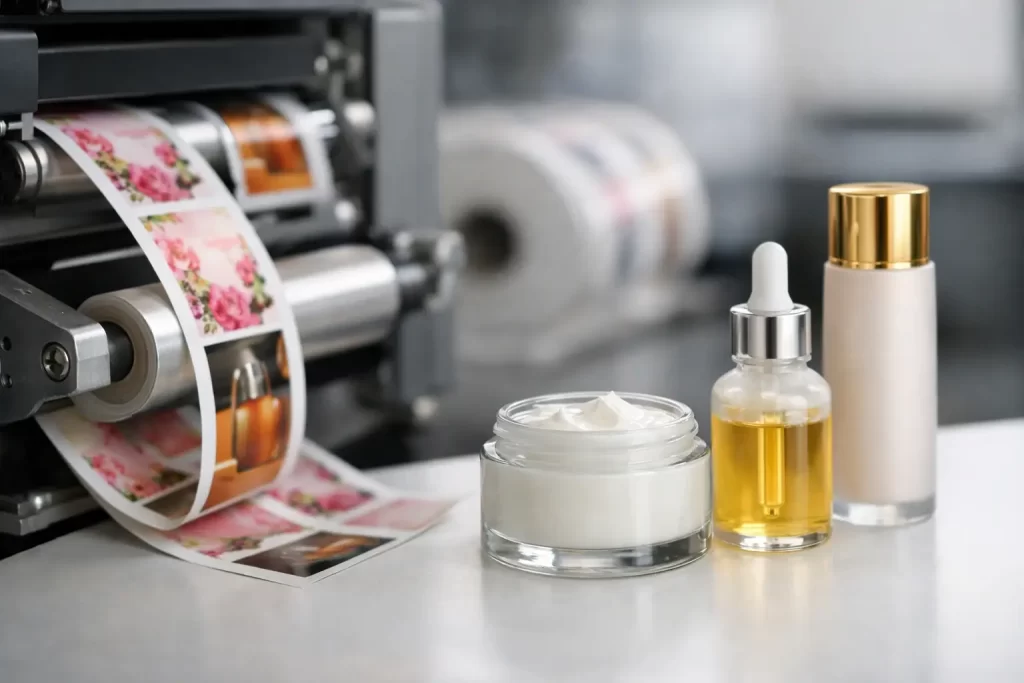
A premium serum can lose credibility in seconds if the label bubbles at the edge, smears in transit, or fades under retail lighting. In beauty packaging, appearance carries commercial weight, but performance matters just as much. That is why cosmetic product label printing needs to be approached as a production decision, not a last-minute design task.
For brand managers, packaging teams, and procurement leaders, the label sits at the intersection of branding, compliance, and operations. It has to look refined, remain legible, adhere to difficult surfaces, and hold up through filling lines, warehousing, shipping, and consumer use. The right print strategy supports all of that. The wrong one creates rework, delays, and avoidable cost.
Why cosmetic product label printing is more demanding than it looks
Cosmetic packaging creates a unique set of pressures. Many products are filled into small containers with limited label real estate. At the same time, those labels often need to carry ingredients, usage directions, caution statements, batch details, and barcode information without compromising visual appeal.
Then there is the environment the label has to survive. Cosmetic jars and bottles are handled repeatedly, exposed to oils, moisture, friction, and in some cases refrigeration or warm storage. A face wash label may face constant water exposure. A body oil bottle may challenge adhesive strength. A luxury cream jar may require a premium tactile finish while still running efficiently on high-speed application equipment.
This is where label printing moves beyond aesthetics. Material selection, adhesive compatibility, print technology, and finishing all shape whether the label performs in the real world.
What business buyers should evaluate first
The best cosmetic label projects usually start with the container, not the artwork. A label that performs well on a flat carton may fail on a curved bottle, squeezable tube, or textured jar. Surface energy, application speed, storage conditions, and product contact all influence the specification.
Container shape is one of the first filters. Straight-walled containers are generally easier to label. Tapered or highly contoured packs may require more flexible materials or a different label construction to avoid lifting and wrinkling. If the product line includes multiple SKUs in different sizes, standardizing where possible can improve print efficiency and reduce production complexity.
Brand requirements come next. Some products need a clean, clinical look. Others need metallic finishes, transparent no-label visuals, or high-opacity whites for bold shelf impact. These choices affect not only the design but also the print process and substrate.
Operational requirements matter just as much. If you are printing short runs for frequent launches, version changes, or regional variants, digital printing may offer stronger flexibility. If you are managing larger, repeat-volume programs with strict color consistency, flexographic printing can deliver strong unit economics and stable output at scale. In many cosmetic portfolios, the right answer is not one or the other. It depends on run length, artwork complexity, and how often the content changes.
Materials and finishes that suit cosmetic product label printing
Material choice is rarely cosmetic in name only. It affects durability, feel, and machine performance.
Film labels are widely used for cosmetic product label printing because they resist moisture and abrasion better than standard paper constructions. Polypropylene is often preferred for bottles, jars, and products likely to be handled in wet environments. It also supports clear-on-clear applications for a refined shelf appearance. Polyethylene can be useful where squeeze performance or conformability is more important.
Paper labels still have a place, especially for dry-use products or brands seeking a natural, textured, or artisanal finish. But paper is more sensitive to moisture, scuffing, and oils. If the product will live in a bathroom, spa, or travel kit, paper needs careful evaluation.
Finishes should be chosen with use conditions in mind. Matte laminates can create a premium, understated look and improve scuff resistance. Gloss finishes increase vibrancy and can support a brighter retail presentation. Foils, embossing, and tactile varnishes add impact, but every enhancement should justify itself in function or brand value. Over-finishing a label can raise cost, slow production, and complicate recyclability.
Adhesive selection is another point where many projects either succeed quietly or fail visibly. Glass, PET, HDPE, and coated surfaces behave differently. So do products stored in humid conditions or subjected to temperature changes during transport. If a label peels after filling or during shelf life, the problem is usually not the artwork. It is the construction.
Print technology and when each approach makes sense
A strong label program aligns print technology with business reality.
Digital printing is well suited to cosmetic brands managing multiple SKUs, promotional variants, or lower-to-mid volume orders. It allows fast changeovers, versioning, and reduced setup constraints. That makes it valuable when ingredient panels shift, marketing teams update claims, or export labeling requirements change across markets.
Flexographic printing remains a strong choice for larger-volume cosmetic production where consistency, speed, and repeatability are critical. For established lines with stable artwork and predictable demand, flexo supports efficient production and dependable results. It also performs well when color control must stay tightly aligned across long runs.
There is no universal winner. A new product launch might begin digitally and move to flexo once volumes stabilize. A portfolio with both hero SKUs and fast-moving seasonal editions may benefit from a mixed production approach. The practical question is not which technology sounds more advanced. It is which one best matches run profile, lead time expectations, and cost structure.
Compliance, traceability, and small-format challenges
Cosmetic packaging often demands more information than the available space comfortably allows. That creates a common tension between branding and compliance. The label has to remain attractive while carrying mandatory content clearly and accurately.
Legibility should never be treated as negotiable. Fine text, ingredient declarations, warning statements, batch codes, and barcodes all need consistent print quality. Poorly rendered small text can create regulatory risk and operational friction, especially when products move across regional markets or through multiple distribution channels.
Traceability is also gaining importance. Batch coding, variable data, and product identification need to remain readable through logistics and end use. For some product categories and supply chains, integrating smart labeling elements can support stronger visibility and control. That level of capability is most useful when traceability is part of a broader packaging and operations strategy rather than a standalone add-on.
Getting shelf impact without creating production problems
In cosmetics, visual differentiation matters. But shelf appeal should not come at the expense of manufacturing reliability.
Highly decorative labels can present hidden production issues. Dense metallic areas, intricate embellishments, and very fine reverse text may look impressive on screen but become harder to reproduce consistently at scale. Transparent labels can create a premium effect, but they also reveal application inaccuracies more easily than opaque constructions. Dark containers may require stronger white opacity to preserve brand colors. Soft-touch finishes feel elevated, but they need to withstand abrasion through packing and transport.
The best label programs balance ambition with repeatability. That usually means involving the print partner early, before artwork is finalized and before procurement locks in a specification that is visually attractive but operationally fragile.
Why supplier capability matters in cosmetic product label printing
Cosmetic labels are rarely a one-time order. They are part of an ongoing production system that has to support launches, replenishment cycles, artwork updates, compliance changes, and quality expectations across multiple SKUs.
That is why supplier evaluation should go beyond price per thousand. Print consistency, substrate knowledge, finishing capability, testing discipline, and delivery reliability all affect total cost. A lower unit price can disappear quickly if labels fail on the line, if approvals take too long, or if color variation forces rework across a product family.
An experienced manufacturing partner should be able to advise on construction choices, not just execute supplied artwork. That includes flagging risks tied to container shape, adhesive performance, and finish selection before they become production issues. For enterprise buyers, this kind of support is not extra service. It is part of quality assurance.
Companies working across demanding product categories often look for suppliers that combine scale with flexibility. That means handling repeat production reliably while also supporting regional variants, promotional runs, and evolving sustainability targets. For businesses sourcing in growth markets such as the GCC, that balance becomes even more valuable when speed, consistency, and supply continuity are under pressure. Manufacturers such as Kimoha approach this with a combination of flexographic and digital capability, application-focused guidance, and industrial quality control.
A better way to think about the label
The most effective cosmetic labels do more than decorate a bottle or jar. They protect brand perception, support compliance, and keep production moving without avoidable disruption. When cosmetic product label printing is treated as a strategic packaging decision, brands gain more control over both presentation and performance.
If you are reviewing a new launch or reassessing an existing SKU, start with the use case, the container, and the operating environment. A label that looks right in a mockup is only halfway there. The one that still looks right after filling, shipping, shelving, and consumer use is the one worth approving.
