


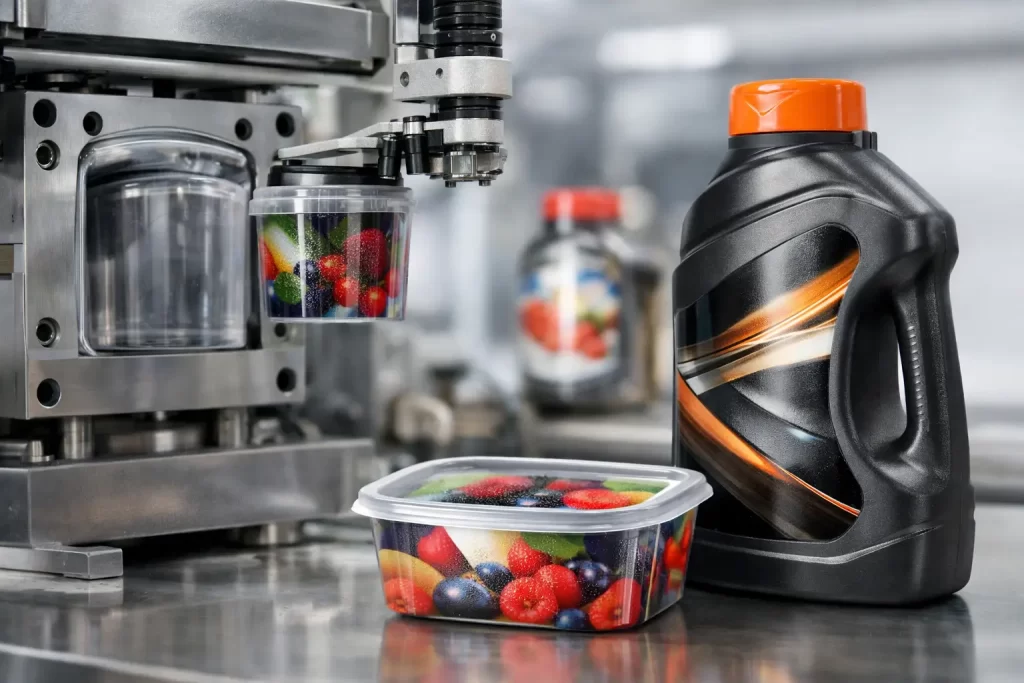
Scuffed containers, peeling labels, and inconsistent shelf presentation create avoidable costs for manufacturers. In mold labels solve that problem at the point of production by becoming part of the container itself, rather than being applied as a separate label after molding. For brands that need packaging to perform in demanding retail, logistics, and consumer-use environments, that difference matters.
What are in mold labels?
In mold labels are pre-printed labels placed inside a mold before a plastic container or component is formed. During injection molding, blow molding, or thermoforming, the label bonds with the plastic wall of the product. The result is a finished package with decoration built directly into the container.
This process changes the role of the label. Instead of acting as a surface-applied element, it becomes part of the final structure. That gives the package a more durable finish and removes the separate labeling step that many production lines rely on.
For procurement teams and packaging managers, the value is practical. You are not just selecting a graphic format. You are choosing a production method that affects line efficiency, appearance consistency, resistance to wear, and long-term brand presentation.
Why in mold labels matter in industrial packaging
Rigid plastic packaging has to do more than look good on the shelf. It has to move through filling lines, warehouses, transport networks, and consumer handling without losing identification or visual quality. In mold labels are often selected because they hold up where pressure-sensitive labels may start to show limitations.
The biggest advantage is durability. Because the label is fused with the container, it resists peeling, wrinkling, and edge lifting. Moisture, friction, refrigeration, and repeated handling are less likely to compromise the package appearance. This is especially useful for food tubs, paint containers, home care packaging, and other products exposed to tough conditions.
There is also a clear branding benefit. In mold decoration can deliver high print quality, strong color performance, and a premium no-label look depending on the substrate and finish selected. For consumer-facing products, that helps maintain a cleaner, more integrated visual identity.
Operationally, in mold labels can support efficiency by reducing secondary application steps. That does not mean every production setup will see instant simplification. The gains depend on machine capability, mold design, automation level, and run volume. But for the right application, integrating labeling into molding can improve consistency and reduce handling.
Where in mold labels are commonly used
This labeling method is most often associated with rigid plastic packaging and durable molded products. Food packaging is one of the strongest use cases, especially for dairy containers, ice cream tubs, spreads, ready-to-eat packaging, and reusable food storage formats. These products benefit from moisture resistance and clean shelf appearance.
Home care and personal care brands also use in mold labels for pails, tubs, and specialty containers where surface durability matters. In industrial sectors, they are a strong fit for lubricant containers, chemical pails, and technical parts that need permanent product identification.
It is not limited to round or simple formats. Depending on the molding process and tooling design, in mold labels can be applied to a wide range of shapes and sizes. That said, container geometry, label placement area, and mold complexity all affect feasibility.
The manufacturing considerations behind performance
A strong in mold labeling result starts long before print. Material compatibility is critical. The label stock must work with the resin used in the molded part so bonding happens correctly during the process. If the material pairing is wrong, the finish, adhesion, or visual result may fall short.
Print quality also has to be engineered for the process. The label must maintain registration, image clarity, and structural stability while being handled and inserted into the mold. Static behavior, thickness, heat resistance, and cut accuracy all influence production performance.
This is where experienced manufacturing support becomes important. In mold labels are not just a design file transferred onto a substrate. They require coordination between artwork, printing, material selection, mold conditions, and line setup. A supplier that understands both label production and industrial application can reduce trial-and-error at launch.
For larger organizations, that matters during qualification. Packaging changes affect procurement, operations, technical teams, and often compliance review. A labeling partner should be able to support that process with consistency and production discipline, not just print capability.
Benefits and trade-offs to evaluate
In mold labels offer a strong case, but they are not the default answer for every packaging line. The best decisions come from understanding both their strengths and their limits.
The benefits are clear. Durability is one of the strongest. Visual integration is another. The label becomes part of the product, which can create a cleaner finish than a separately applied label. There may also be process advantages when secondary labeling is removed or reduced.
The trade-offs usually come down to setup and application fit. In mold labeling often requires more planning at the tooling and production stage. If a brand changes artwork frequently, runs short volumes, or uses packaging formats not suited to the process, another labeling method may offer more flexibility. Initial development can also be more demanding because print, materials, and molding conditions have to align closely.
That does not make it less valuable. It simply means in mold labels work best when the packaging program is stable enough to justify the integration and when durability or presentation are central to the product brief.
How to decide if in mold labels are right for your packaging
The first question is functional, not aesthetic. Ask what your package has to endure. If your current labels are failing under moisture, abrasion, cold-chain handling, or repeated use, in mold labels deserve serious evaluation.
The second question is operational. Review how your containers are made today and whether the production environment supports in mold integration. If your packaging is already molded at scale, the opportunity is easier to assess. If the line depends on outsourced components or highly variable formats, the case may be less straightforward.
The third question is commercial. Premium shelf presence, label permanence, and fewer post-mold labeling steps can create value, but that value has to be measured against tooling, setup, and production realities. A lower unit cost on paper does not always translate into a better packaging system overall. The opposite is also true. A slightly more engineered solution can reduce defects, improve consistency, and strengthen brand execution over time.
For enterprise buyers, the right decision usually comes from a cross-functional review. Procurement may focus on total cost, while brand teams prioritize finish and print quality, and operations teams care about machine performance and throughput. In mold labels tend to perform best when those priorities are aligned early.
What to expect from a qualified label manufacturing partner
A capable supplier should help you evaluate feasibility, not just quote a specification. That means discussing resin compatibility, print technology, finish options, application conditions, and expected production volumes. It also means understanding whether your packaging goals are driven by durability, decoration, sustainability, or all three.
Quality control is especially important. In mold labels must be produced with tight consistency because even small variations can affect placement and bonding in high-speed manufacturing. Precision in print, die-cutting, and material handling directly supports line performance.
For regional and multinational brands operating across the GCC, supply reliability matters as much as technical performance. Packaging programs often run on fixed production timelines, and label availability can affect the entire filling and distribution schedule. An experienced manufacturing partner brings value by combining technical guidance with dependable delivery and scale.
Kimoha’s approach in this space reflects what industrial buyers typically need – print precision, application-focused support, and the ability to align labeling performance with broader packaging requirements.
In mold labels and the shift toward smarter packaging decisions
Packaging teams are under pressure from every direction. They need stronger shelf impact, fewer quality issues, more sustainable material choices, and better production efficiency. In mold labels answer some of those pressures very effectively, but only when they are selected for the right product and built into the packaging strategy from the start.
That is the real opportunity. Not to treat labels as a late-stage decoration choice, but to treat them as part of the product’s engineering, performance, and brand value. When that happens, the package works harder across the supply chain and looks better doing it.
If your packaging has to stay sharp from molding line to end use, in mold labels are worth evaluating with the same seriousness you would give any other production-critical component.
