


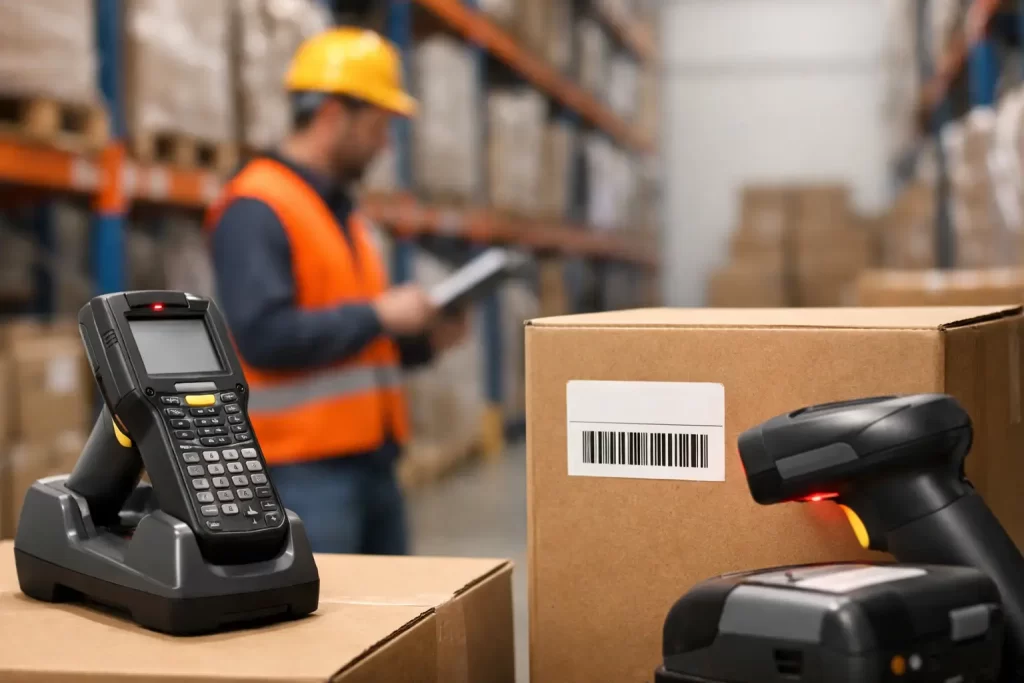
A warehouse rarely fails because of one major system breakdown. More often, performance erodes through small identification errors – the wrong pallet scanned, a damaged label on a cold-storage carton, a location tag that fades too early, or a barcode that prints well in one facility but not in another. That is why barcode labels for warehouse operations deserve more attention than they usually get. They are not a commodity detail. They are a control point for inventory accuracy, throughput, traceability, and operational discipline.
When labels are specified correctly, teams scan faster, exception handling drops, and stock movement becomes easier to trust. When labels are treated as an afterthought, even a well-run warehouse can absorb avoidable delays, mispicks, returns, and reconciliation work.
Why barcode labels for warehouse operations matter
In most warehouse environments, the label is the physical link between the product, the location, and the system record. If that link is weak, every downstream process carries more risk. Receiving may log the right goods under the wrong item number. Put-away may send inventory to the wrong bin. Replenishment may slow down because operators stop to key in data manually. Shipping may suffer from carton verification errors that should have been prevented at scan point.
Barcode labels support more than identification. They support repeatability. A good warehouse process depends on standard inputs, and labels are one of the most visible of those inputs. Size, adhesive, print contrast, face material, barcode symbology, and data formatting all influence whether scanning works consistently across shifts, sites, and handling conditions.
This is where procurement and operations teams often need a more technical view. The right label is not simply the cheapest printable stock. It is the stock that performs under the actual environmental and handling conditions of the site, while also supporting the scanning equipment and data structure already in use.
Choosing the right barcode label starts with the job
A warehouse can use several label types at once, and that is usually the correct approach. Pallet labels, rack labels, shelf labels, tote labels, carton labels, and product identification labels serve different functions. Treating them as one category often leads to overspecification in some areas and underperformance in others.
For example, rack location labels usually need long-term durability and strong resistance to abrasion, dust, and cleaning. Carton labels may only need to last through storage and shipment. Frozen goods labels require adhesives and materials that tolerate low temperatures and condensation. Chemical or industrial environments may demand stronger topcoats or synthetic constructions because paper labels can degrade too quickly.
The key question is simple: what must this label survive, and for how long? Once that is clear, material selection becomes more precise.
Material and adhesive decisions affect scan reliability
Paper labels can be cost-effective for controlled indoor use, short lifecycle applications, and standard corrugated packaging. They are widely used and often entirely suitable. But paper is not always the right answer where moisture, rough handling, or extended storage are part of the workflow.
Synthetic materials such as polypropylene or polyester offer greater durability and dimensional stability. They are often a better fit for reusable containers, long-term location marking, and environments with variable temperatures or exposure to friction. Adhesive selection matters just as much. A barcode label that peels, lifts at the corners, or struggles to bond to shrink wrap, plastic totes, or textured corrugated board can create scanning failures even if print quality is excellent.
The trade-off is cost versus service life. Not every warehouse needs premium synthetic construction across every application. But high-traffic, high-value, or compliance-sensitive operations usually benefit from matching label specification to operational risk rather than unit price alone.
Print quality is where many barcode problems begin
Teams often blame scanners when the actual issue is print performance. Barcode readability depends on edge definition, contrast, quiet zones, and consistent print density. If a printer is poorly calibrated or a label stock is incompatible with the print method, scan rates will suffer.
Thermal transfer labels are often preferred in warehouse settings because they provide durable, stable images suitable for many logistics applications. Direct thermal can work well for short-life labeling, especially where speed matters and exposure conditions are limited. But direct thermal images can darken or fade when exposed to heat, friction, or light, which makes them less suitable for some warehouse environments.
There is no universal winner between print technologies. It depends on handling conditions, expected label life, and whether the label is part of an internal process or a broader shipping and traceability chain.
Barcode design should match real scanning conditions
Barcode size and format should be set for the scanner, the scan distance, and the surface where the label is applied. A barcode that works on a clean sample at a desk may fail on a curved container, a dusty pallet wrap, or a fast-moving conveyor line.
Data density is another common issue. Teams sometimes try to fit too much information into a small label area, forcing the barcode to become too compact for reliable scanning. In other cases, human-readable text is too small to support manual fallback when scans fail. Good label design respects both machine and operator use.
Linear barcodes such as Code 128 remain common in warehouse applications because they are efficient and widely supported. Two-dimensional codes can carry more data and may be useful in traceability-heavy environments, but they are not automatically better. The right format depends on the system architecture and the actual operational need.
Warehouse labeling works best as a system, not a purchase line
A warehouse gains the most value when barcode labels are treated as part of the larger identification system. That means aligning label construction with printers, scanners, software, application methods, and handling conditions.
If labels are printed in-house, consistency depends on ribbon selection, printer maintenance, operator training, and approved templates. If labels are preprinted, it is essential to control tolerances, variable data accuracy, and production quality. In both cases, testing should happen in live conditions, not only in a conference room or QA lab.
This system view is especially important in multi-site operations. A label that performs well in one facility may fail in another because of different racking heights, temperatures, substrate types, or scanning hardware. Standardization helps, but only when it is based on tested operational reality.
Where barcode labels create measurable gains
The direct value of better labels is usually seen in fewer scan failures and clearer identification. The broader value is operational. Receiving becomes faster when cartons and pallets scan cleanly on first pass. Put-away improves when location labels remain legible and fixed over time. Picking becomes more reliable when item and bin labels are easy to distinguish and scan under pressure. Shipping improves when verification labels support accurate order consolidation and dispatch.
There is also a traceability advantage. In regulated or quality-sensitive sectors such as healthcare, food, and industrial manufacturing, labeling supports accountability across movement, storage, and shipment. When the barcode remains readable throughout the product journey, teams can track more confidently and respond faster when exceptions occur.
For businesses evaluating process improvements, this is often where the return becomes clear. Better labels do not only reduce replacement frequency. They reduce labor disruption, rework, and uncertainty.
When to look beyond standard barcode labels
Some operations reach a point where barcode labels alone are not enough. High-volume facilities, reusable asset tracking programs, or advanced visibility initiatives may benefit from RFID-enabled labeling alongside traditional barcodes. That does not replace the need for strong barcode design. It expands the identification strategy where speed, automation, or non-line-of-sight reading adds value.
For many businesses, the smarter move is not replacing barcode labels but improving the foundation first. That means specifying materials correctly, validating print quality, and designing labels around actual workflows. Once that base is stable, additional technologies become easier to justify and deploy.
What to ask a labeling partner
A capable labeling partner should be able to discuss substrate compatibility, adhesive behavior, print methods, barcode verification, and application-specific durability without reducing the conversation to standard stock options. Warehouse operations are too variable for one-size-fits-all recommendations.
That is why experienced manufacturers focus on use case first. A logistics label for ambient storage is different from a freezer label, and a rack marker has different demands than a shipping carton label. Companies such as Kimoha work with this practical view because industrial labeling performs best when material science, print precision, and operational context are considered together.
The most effective warehouse labels are rarely the most noticeable part of the operation. They simply keep working – across shifts, surfaces, scanners, and handling conditions. When that happens, the warehouse runs with fewer interruptions, and the data behind it becomes far more dependable.
