


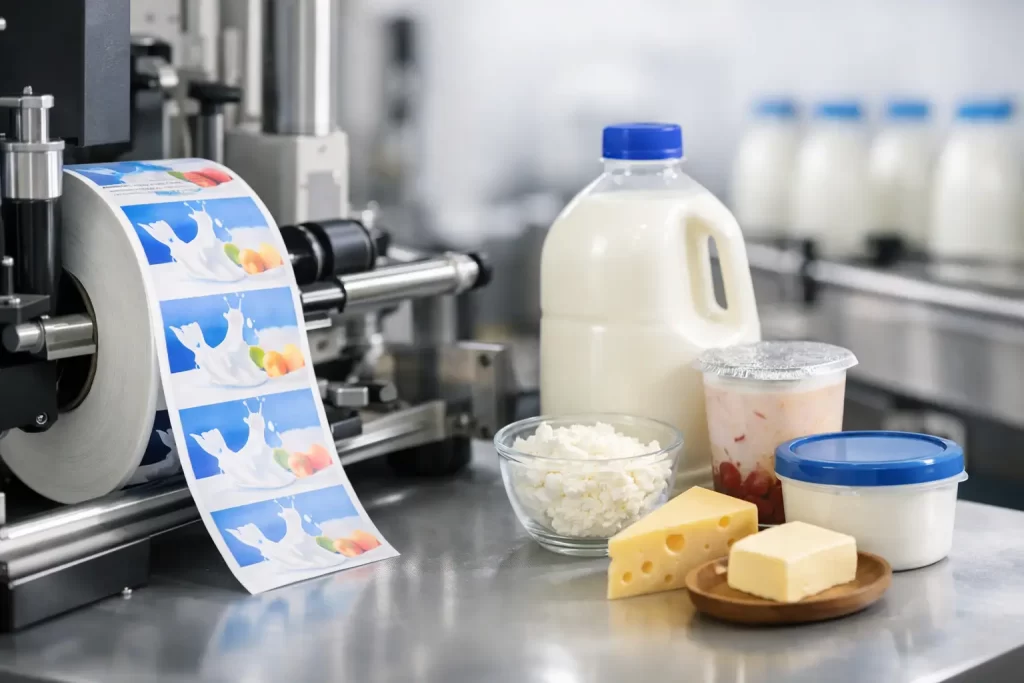
Milk sweats. Yogurt cups chill, warm up, and chill again. Cheese packs flex, stack, and move through cold-chain distribution. That is why dairy product label printing is not a routine packaging task. It is a performance decision that affects compliance, shelf presence, production uptime, and brand trust.
For dairy brands and packaging teams, the label has to do more than look good on press. It must stay legible in refrigerated conditions, hold adhesion on challenging surfaces, and carry accurate information every time. If any part of that fails, the issue shows up quickly – in returns, relabeling, scan failures, or a product that simply looks poor at retail.
Why dairy product label printing is more demanding
Dairy packaging creates a difficult environment for labels. Condensation is common. Surfaces may be curved, damp, cold, or slightly textured. Products often move through fast filling lines and then into storage and transport conditions where temperature shifts are routine.
At the same time, dairy is a category where trust matters immediately. Consumers check dates, ingredients, nutritional panels, and product variants closely. Retailers expect clean barcodes and consistent pack presentation. Internal teams need labels that run reliably at scale without causing waste or line stoppages.
That combination – environmental stress, regulatory pressure, and brand visibility – makes material and print choices more consequential than many buyers expect.
What good dairy labels need to achieve
A high-performing dairy label has three jobs. First, it must remain attached and readable throughout the product lifecycle. Second, it must meet labeling and traceability requirements without variation. Third, it must support brand differentiation in a crowded refrigerated case.
Those goals can conflict if the label is not engineered correctly. A premium decorative finish may look strong in concept but underperform in wet handling. A low-cost material may save on unit price while increasing spoilage risk or creating application issues on the line. The right specification usually comes from balancing print quality, adhesive performance, substrate compatibility, and production conditions rather than optimizing for one factor alone.
Adhesion in cold and wet conditions
Cold-chain performance is one of the first considerations in dairy product label printing. Adhesives must be selected for application temperature, service temperature, and the packaging surface itself. A label applied to a dry HDPE bottle behaves differently from one applied to a chilled cup with light surface moisture.
This is where testing matters. The same face stock and adhesive combination may perform well on one SKU and poorly on another due to shape, curvature, storage timing, or line speed. Procurement teams often focus on the printed label as a finished item, but operations teams know the application environment is just as important.
Print clarity for compliance and traceability
Dairy labels carry information that cannot fail in the field. Nutrition facts, ingredient statements, allergen declarations, batch details, and date coding must remain crisp and readable. If the label design includes variable data, barcodes, QR codes, or tracking elements, print precision becomes even more critical.
For enterprise brands, consistency across runs also matters. A label that shifts in color, registration, or code readability from one batch to the next creates unnecessary risk. This is especially true for brands managing multiple SKUs, multilingual packaging, or regional compliance requirements.
Shelf impact without sacrificing function
Dairy is highly visual. In many retail environments, products are chosen quickly, often from dense shelves with little time for comparison. Strong label design helps, but print execution determines whether that design actually works at shelf level.
Whites must appear clean, colors must remain stable, and fine text must hold sharp detail. For products positioned as premium, natural, family-focused, or health-oriented, the label is a direct expression of the brand promise. If the print looks inconsistent or the label edges lift after refrigeration, the package sends the wrong signal.
Choosing the right print approach
There is no single best method for dairy product label printing. The right approach depends on volume, SKU complexity, lead times, and the level of variation across product lines.
Flexographic printing is often the preferred choice for long runs where speed, consistency, and cost efficiency matter. It supports reliable reproduction at scale and works well for established dairy lines with predictable volumes. Digital printing is valuable when brands need shorter runs, faster artwork changes, versioning, or SKU expansion without the cost structure of traditional plate-based setups.
In practice, many dairy manufacturers benefit from access to both capabilities. Product launches, seasonal flavors, regional variants, and promotional packs may require flexibility, while core SKUs demand stable, high-volume output. A manufacturing partner with both flexographic and digital capacity can align the print process with the commercial reality of the product line.
Material selection shapes performance
The face stock and adhesive combination should be chosen based on application, storage, and end-use handling. Filmic materials are often used where moisture resistance and durability are priorities. Paper labels can still be effective in some dairy applications, especially where the packaging environment is controlled and the desired look supports the brand.
Shrink sleeves may be the better choice when brands want full-container decoration, tamper evidence, or stronger visual impact on curved containers. For certain formats, they also allow more communication space without increasing pack size. The trade-off is that sleeve applications require careful integration with container design, application equipment, and recycling considerations.
This is where an industrial labeling partner adds value beyond print supply. Material recommendations should come from real production knowledge, not from generic assumptions about what works in food packaging.
Compliance cannot be treated as artwork alone
In dairy, label compliance is tied directly to operational control. Small errors in content placement, print legibility, or version management can create outsized consequences. Teams managing multiple product formats or private-label programs know how quickly these issues become expensive.
That is why approval workflows, version control, and print inspection standards matter just as much as design quality. The label supplier should be able to support repeatable execution, not just attractive samples. For regulated and high-volume categories, quality assurance must be built into the process from prepress through finished delivery.
The role of variable data and smart labeling
Many dairy operations are placing more emphasis on traceability, stock movement, and product authentication. Variable data printing supports batch coding and serialized information, while smart label technologies can strengthen supply chain visibility.
Not every dairy application needs RFID or advanced track-and-trace features, but the demand is growing in complex distribution environments. For businesses planning for future traceability requirements, it helps to work with a label manufacturer that understands both current packaging needs and the direction of smart labeling.
Sustainability is part of the specification now
Sustainability in dairy packaging is no longer limited to broad brand statements. Buyers increasingly ask practical questions about material reduction, recyclability, liner waste, and compatibility with broader packaging sustainability goals.
There is rarely a perfect answer. A more sustainable material must still survive refrigeration and distribution. A downgauged option may reduce material use but require careful testing to avoid application issues. Sustainable label decisions work best when they are treated as performance decisions as well as environmental ones.
For procurement and packaging teams, that means evaluating trade-offs honestly. The better path is usually not the most visible sustainability claim. It is the option that improves environmental outcomes while protecting compliance, runnability, and product presentation.
What to look for in a dairy label manufacturing partner
A strong supplier for dairy labels should bring more than print capacity. They should understand food packaging environments, offer guidance on material and adhesive selection, and maintain quality systems that support consistency across runs. They should also be equipped to scale with the business, whether the need is a stable national SKU range or a fast-moving portfolio with frequent artwork changes.
Regional service can also matter, particularly for brands managing multiple production sites or distribution across GCC markets where speed, responsiveness, and supply continuity are operational priorities. Manufacturers such as Kimoha support this need by combining advanced print capabilities with industry-specific label production experience.
The real value of the right partner is not just better labels. It is fewer line issues, better pack consistency, stronger compliance confidence, and a packaging process that supports growth rather than slowing it down.
Where good decisions pay off
Dairy labels are often judged at the shelf, but their real test starts much earlier – on the line, in cold storage, in transport, and in handling. When dairy product label printing is specified correctly, the result is not only a better-looking package. It is a more reliable product system.
That matters because in dairy, small packaging failures rarely stay small. The best label programs are built with the same discipline as the products they represent – precise, consistent, and ready to perform where it counts.
