


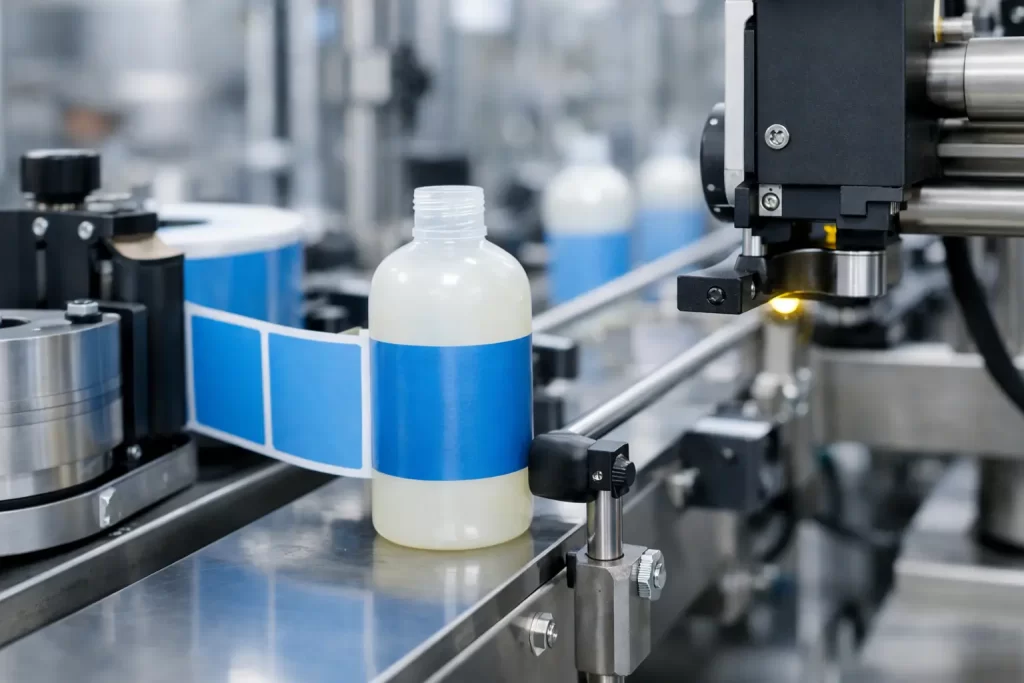
A labeling issue rarely starts at the label. It usually shows up later – when a scanner misses a code, a bottle reaches retail with wrinkled graphics, or a batch has to be pulled because mandatory information was printed out of position. That is why packaging line labeling deserves attention at the system level, not as a last-stage add-on.
For manufacturers and brand owners, labeling performance sits at the intersection of operations, compliance, and presentation. A label must apply cleanly at line speed, stay legible through transport and storage, and carry the right information in the right format every time. If any part of that chain is weak, the cost is bigger than rework. It can affect uptime, traceability, and brand credibility.
Why packaging line labeling affects more than appearance
On a live production line, the label is one of the few packaging elements that carries both visual branding and critical operational data. It may need to display ingredients, dosage details, handling instructions, barcodes, QR codes, RFID functionality, serial numbers, or tamper evidence. In many sectors, it also has to meet strict regulatory and durability requirements.
That makes packaging line labeling a production discipline, not just a design choice. A label that looks sharp in prepress can still fail if the face stock is wrong for the container, the adhesive does not suit the surface, or the application setup cannot hold registration at speed. The best results come from treating label construction, print quality, applicator performance, and environmental conditions as one connected process.
This is especially true in high-volume categories such as FMCG, food and beverage, healthcare, logistics, and home care, where even a small inconsistency can multiply across thousands of units in a single shift.
What reliable packaging line labeling really depends on
A strong packaging line starts with matching the label specification to the actual use case. Container material matters. Glass, PET, HDPE, corrugate, films, and metal all behave differently. So do curved surfaces, squeezable packs, and secondary packs exposed to warehouse handling. The adhesive that performs well on dry cartons may not be suitable for chilled bottles or low-surface-energy plastics.
Print method matters too. If the requirement is high-impact brand graphics across long runs, flexographic production often offers excellent consistency and scale. If there are frequent SKU changes, regional variants, or variable data needs, digital production may offer better agility. In many operations, the right answer is not one or the other. It depends on run length, artwork complexity, speed expectations, and data demands.
Then there is application accuracy. Even a well-made label can underperform if dispensing tension, line speed, wipe pressure, or sensor calibration are off. Misalignment is not always dramatic. Sometimes it appears as a small edge lift, a slight skew, or barcode placement that falls outside scanner tolerance. Those minor errors are often the first sign that the system needs adjustment.
Common failure points on the line
When decision-makers review labeling complaints, the discussion often starts with print quality. In practice, line failures are usually more layered than that.
One frequent problem is poor adhesion caused by a mismatch between the label material and the actual packaging environment. Condensation, dust, oil, curved containers, textured substrates, and temperature swings can all reduce bond strength. If packs are filled hot, chilled after labeling, or stored in humid conditions, the label has to be built for that sequence.
Another issue is inconsistent data printing. Batch codes, expiration dates, and serialized information must stay sharp and scannable. If thermal transfer settings, ribbon choice, printhead condition, or substrate compatibility are neglected, variable data becomes the weak point even when the main graphic print looks excellent.
There is also the matter of speed. Operations teams often push for faster throughput, but not every label construction behaves well at every line speed. Thin films may react differently from paper stocks. Small-format labels can be harder to dispense accurately than larger formats. Applicator settings that work well at medium speed may begin to drift under peak output.
In regulated sectors, the consequences are higher. A label placed a few millimeters off can interfere with mandatory copy, tamper-evident features, or machine-readable zones. What seems minor on the line can create compliance exposure later.
Choosing label materials for line performance
The best label stock is not always the most premium-looking one. It is the one that fits the pack, the process, and the end-use conditions without compromising brand presentation.
Paper labels can be highly effective for many dry goods, cartons, and general packaging applications. They offer strong printability and can support a wide range of finishes. Filmic labels often bring better moisture resistance, durability, and conformity on squeezable or curved containers. Shrink sleeves may be the right choice when full-body decoration, tamper evidence, or high shelf presence is the goal, though they come with their own application and recycling considerations.
Adhesive selection deserves equal attention. Permanent, removable, freezer-grade, high-tack, and specialty adhesive systems all serve different operational needs. A procurement decision based only on unit cost can create much larger losses if labels fail in storage, transport, or retail handling.
For companies moving toward smarter supply chains, RFID-enabled labels can add another layer of functionality. They support traceability, inventory visibility, and authentication, but only if the label design, inlay placement, and application conditions are engineered properly. Smart labeling can improve control across logistics and retail environments, but it requires technical alignment from the start.
Packaging line labeling and compliance
Compliance is where labeling errors become expensive very quickly. Product identifiers, warnings, ingredient panels, dosage instructions, lot codes, and country-specific declarations all need to be clear, durable, and consistently placed.
For healthcare and pharmaceutical-related applications, readability and traceability are central. For food and beverage, moisture exposure, cold-chain conditions, and high turnover create another set of requirements. In logistics and aviation-related environments, the priority may be scan reliability, handling resilience, and accurate tracking. Each sector has its own pressure points, which is why a generic label specification often underperforms.
This is where experienced manufacturing support matters. Converting requirements into a production-ready label solution means understanding not just print, but substrates, adhesives, line behavior, and the downstream realities of storage, transport, and scanning.
How to improve packaging line labeling without slowing output
The most effective improvements usually begin with a practical audit. Review where issues happen: at dispensing, after filling, during case packing, in cold storage, or at the retailer. A label that passes inspection on the line may still fail later in the chain.
It also helps to evaluate labels by application, not just by SKU. Two products with similar branding may need different constructions if one is exposed to moisture and the other is not. The same applies to regional rollouts, multi-language packs, or promotional runs with variable data.
Line trials are worth the effort. Testing label materials and adhesive combinations under real operating conditions gives better answers than relying on datasheets alone. This is particularly important when introducing new containers, increasing throughput, or shifting to more sustainable packaging formats.
Supplier capability should be part of the equation as well. A label partner should be able to support print consistency, conversion precision, material selection, and repeatable delivery at production scale. For business buyers, that reliability is often what separates a workable specification from a dependable long-term solution.
Kimoha supports this kind of requirement with custom printed labels, RFID-enabled smart labels, shrink sleeves, security labels, and packaging accessories designed for demanding industrial applications.
When shelf impact and operational performance must work together
There is often a false trade-off between branding and line efficiency. In reality, the strongest label programs deliver both. High-impact graphics mean little if the label wrinkles, lifts, or scans poorly. At the same time, a perfectly functional label that weakens brand presence can limit product performance in crowded categories.
The goal is balance. That may mean adjusting the finish to improve application, redesigning the label format for better placement tolerance, or using a different material that supports both visual quality and durability. In some cases, it may mean separating primary branding from traceability functions so each can perform more reliably.
That kind of decision-making is rarely solved by artwork alone. It takes manufacturing insight, application knowledge, and a clear view of the product’s full journey.
Packaging line labeling works best when it is treated as part of the production system from the beginning. When the label is engineered for the substrate, the environment, the line speed, and the compliance need, it stops being a recurring point of risk and starts doing its real job – protecting accuracy, supporting efficiency, and helping the product show up exactly as the brand intended. That is usually where stronger packaging performance begins.
