


A security label that looks impressive on paper can fail quickly in the field. It may tear too easily during application, lose readability in cold-chain storage, or offer tamper evidence that does not match the real threat. That is why knowing how to select security label features starts with operational risk, not aesthetics.
For procurement teams, packaging heads, and brand owners, the right label is rarely a single-feature decision. It is a balance of tamper evidence, authentication, print durability, substrate compatibility, and production efficiency. The best choice protects the product, supports compliance, and fits the realities of your supply chain.
How to select security label features for real-world use
The first question is not which feature is most advanced. It is what problem the label must solve. A pharmaceutical carton, a logistics asset, and a premium retail pack face very different risks. Some need visible tamper evidence to reassure customers and inspectors. Others need covert elements that help internal teams verify authenticity without signaling every detail to counterfeiters.
This is where many projects go off track. Decision-makers sometimes specify a feature because it sounds secure, then discover it increases cost, slows application, or adds little value against the actual threat. A better approach is to define the use case in clear terms: what must be protected, who may tamper with it, where in the supply chain exposure is highest, and how verification will happen.
When those questions are answered early, label design becomes more precise. You are no longer buying a generic security product. You are selecting a targeted performance system.
Start with the risk profile
A high-value electronic component may need a label that leaves clear evidence when removed and also carries serialized data for traceability. A healthcare product may require authentication features tied to compliance and patient safety. A warehouse carton moving through rough handling may need stronger material performance than a boutique retail item displayed in controlled conditions.
Risk profiling should cover three layers: likelihood of tampering, business impact if tampering occurs, and detectability after the event. If the impact is severe, visible deterrence alone may not be enough. You may need layered security, such as destructible face stock plus variable data or hidden print elements.
This is also where industry context matters. Food and beverage brands often focus on package integrity and consumer trust. Automotive and electronics programs may emphasize warranty protection and part authentication. Logistics operations may prioritize tracking, scan reliability, and resistance to abrasion or moisture.
Match security features to the threat level
Not every security label needs the same architecture. Simple tamper-evident constructions can be highly effective when the main goal is to show interference quickly and clearly. These are often a strong fit for cartons, closures, and secondary packaging where immediate visual inspection matters.
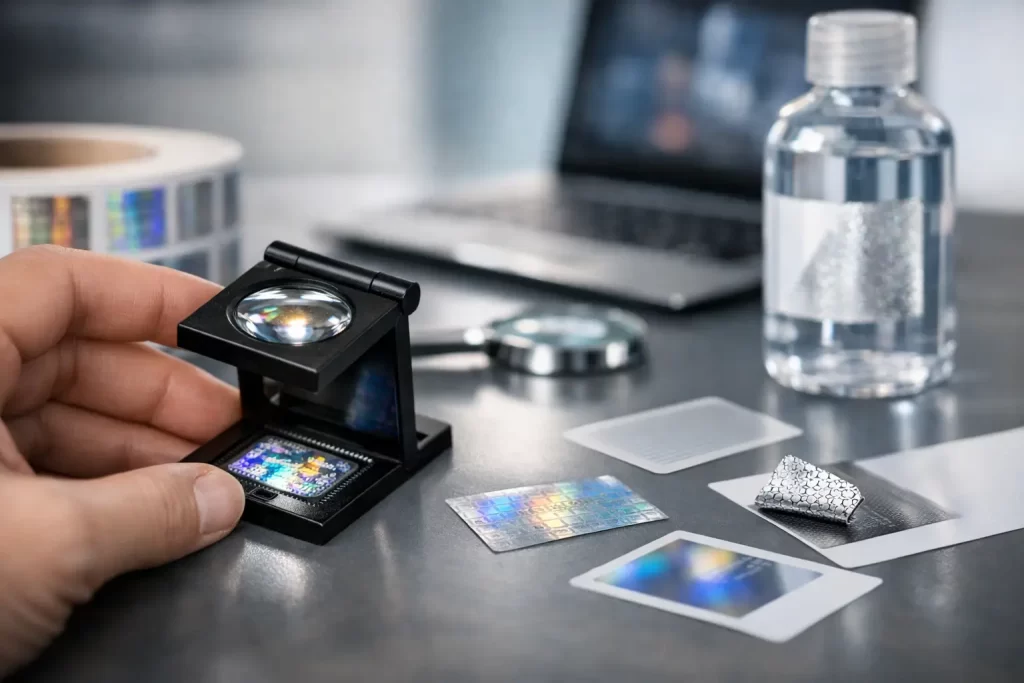
If counterfeiting is a bigger concern, authentication features become more relevant. These can include serial numbering, barcodes, QR codes, holographic effects, UV elements, or custom print signatures. The right combination depends on who needs to authenticate the label. If warehouse staff or retailers must check it quickly, visible and easy-to-read features work best. If verification is handled by trained personnel, covert features may add more control.
There is a trade-off here. Highly visible features can deter fraud, but they can also be copied if the design is too predictable. Covert or semi-covert options improve security depth, but only if the customer has a practical process for inspection. A feature that no one checks consistently is not adding much protection.
Tamper evidence is not one-size-fits-all
Tamper-evident labels come in different formats, and the differences matter. Destructible labels fracture on removal, making reuse difficult. Void labels leave a message or pattern behind when lifted. Seal labels can bridge pack openings and show direct access attempts.
The right choice depends on both packaging material and removal behavior. A void construction may work well on smooth substrates where message transfer is reliable. A destructible film may be better when preventing label transfer is the priority. On textured, curved, or low-energy surfaces, adhesive behavior becomes critical. A label can have the right security concept and still underperform if adhesion is not validated for the actual package.
This is why testing should never be treated as a formality. Surface type, storage temperature, humidity, and dwell time all affect performance.
Authentication should support operations, not complicate them
Serialized labels, track-and-trace coding, and digital verification tools can significantly strengthen product protection. They are especially useful when you need to trace units through production, distribution, and after-sales channels. But the technology must fit the process.
If serial data is added, teams need a clean method to generate, print, capture, and reconcile that data. If QR codes are part of the security strategy, print quality and scan performance must remain stable under real handling conditions. If RFID is under consideration, the packaging environment and read points need to be defined early.
For many B2B buyers, the right answer is not the most complex feature set. It is the feature set that operations teams can use consistently at scale.
Consider material, adhesive, and print durability together
One of the most overlooked parts of how to select security label features is the relationship between security and construction. Features do not work in isolation. Face stock, adhesive, liner, print method, and finishing all influence the final result.
A strong security pattern has limited value if the print fades, the adhesive fails, or the label curls during storage. Products moving through cold storage, outdoor logistics, chemical exposure, or high-friction handling need material selections that hold performance over time. In these environments, durability is part of security.
Adhesive selection deserves special attention. Permanent adhesives are common, but the specific formulation should match the substrate and service conditions. Glass, corrugated board, HDPE, metal, and coated paper all behave differently. If the package is exposed to moisture, oils, or temperature swings, those variables should shape the specification from the start.
Print durability is equally important for labels carrying variable data or verification marks. Smudged codes, worn text, or reduced contrast can turn a secure label into an unreliable one. That affects not only security but also compliance and traceability.
Brand presentation still matters
Security labels are functional, but they are also visible brand assets in many applications. On consumer-facing packs, they should reinforce trust without looking like an afterthought. Print clarity, color consistency, and finish quality all contribute to that impression.
This does not mean security has to compete with branding. In a well-designed program, the two support each other. A premium appearance can improve perceived product authenticity, while integrated security elements preserve brand value in the market.
For companies managing multiple SKUs, this often means developing a security label framework rather than separate one-off designs. Standardized logic with controlled variations can improve procurement efficiency and support brand consistency across product lines.
Ask the right supplier questions before approval
The most effective specifications usually come from collaborative development, not isolated purchasing. Before final approval, buyers should understand how the label will be produced, tested, and controlled through repeat orders.
Ask how tamper performance is validated on your packaging surface. Ask what print tolerances apply to variable data and fine security details. Ask whether the supplier can maintain consistency across volumes, production runs, and regional delivery schedules. If compliance or audit requirements apply, confirm documentation and quality controls early.
An experienced manufacturing partner should be able to explain not only what feature is available, but why it suits the application and where its limits are. That level of clarity reduces costly redesigns later.
Pilot before full rollout
Even well-specified labels benefit from a pilot phase. Trialing in actual production and distribution conditions reveals issues that lab checks may miss. Application speed, dispensing behavior, scan rates, carton interaction, abrasion, and field inspection all need confirmation.
This is especially important when introducing layered security or smart labeling elements. A small pilot helps validate performance without disrupting production at scale. It also gives operations, quality, and procurement teams a shared basis for approval.
For companies looking to align protection, traceability, and manufacturing consistency, working with a specialist partner such as Kimoha can make that evaluation process far more precise.
The strongest security label is not the one with the longest feature list. It is the one built for your product, your risk, and your workflow – and proven before it reaches the market.
