


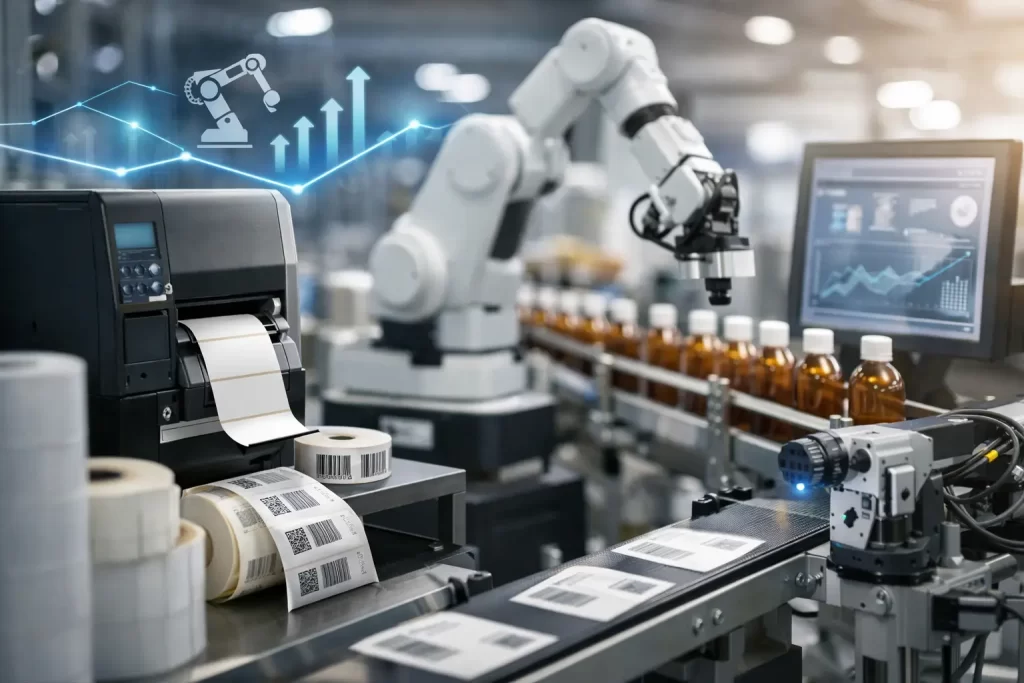
A labeling line rarely gets attention when everything works. The pressure shows up when SKU counts grow, compliance rules tighten, or a late data change forces a reprint window that production cannot afford. That is exactly why label printing automation trends matter right now. They are not just about faster output. They are about reducing errors, protecting traceability, and giving operations teams more control over quality at scale.
For manufacturers, brand owners, and logistics-led businesses, the shift is practical. Automation in label printing is moving beyond isolated print equipment and into connected production environments where data, inspection, and material decisions work together. The result is a smarter labeling process that supports both operational efficiency and brand performance.
Why label printing automation trends are accelerating
The biggest driver is complexity. Many businesses now manage more SKUs, more regional compliance requirements, more short-run promotions, and more frequent packaging updates than they did even a few years ago. Manual checkpoints that once seemed manageable now create bottlenecks.
At the same time, the cost of labeling mistakes has gone up. A misprinted barcode, an incorrect batch number, or inconsistent application can disrupt shipping, trigger compliance concerns, or undermine shelf presentation. Automation reduces these risks by making label production and verification more data-led and less dependent on manual intervention.
There is also a labor reality. Skilled operators remain essential, but companies are asking those teams to manage more complexity with tighter timelines. Automation helps by shifting repetitive work into systems while allowing operators to focus on oversight, setup control, and exception handling.
1. Variable data printing is becoming a standard requirement
One of the most visible label printing automation trends is the expansion of variable data printing across mainstream production. What was once reserved for specialized applications is now increasingly expected in food, healthcare, logistics, retail, and industrial products.
This matters because many labels no longer carry fixed content only. They include dynamic fields such as batch numbers, serial numbers, manufacturing dates, expiration dates, QR codes, RFID-linked identifiers, and market-specific regulatory information. Automated print workflows can pull this information directly from enterprise or production systems, reducing the chance of manual data entry errors.
The trade-off is that variable data demands stronger file governance and process discipline. If the source data is wrong, automation can reproduce errors very efficiently. Businesses benefit most when print automation is paired with approval controls and validation rules upstream.
2. Print-and-inspect systems are tightening quality control
Speed without verification creates risk. That is why automated inspection is becoming central to modern label production. Cameras, barcode grading systems, and sensor-based inspection tools can now check print quality, data accuracy, registration, and readability during production rather than after the fact.
This is especially valuable in sectors where traceability and compliance are non-negotiable. Pharmaceutical, healthcare, food, aviation, and logistics operations often need confidence that labels are not only present but correct and scannable. Automated inspection helps catch defects early, which reduces waste and prevents downstream disruption.
Still, inspection systems are not all equal. Some are designed for simple presence checks, while others support high-resolution verification tied to audit needs. The right level depends on product risk, application speed, and the cost of failure in the field.
3. RFID integration is moving from niche to scalable deployment
RFID has been discussed for years, but automation is making it more practical in larger labeling programs. As encoding, verification, and application technologies improve, RFID-enabled labels are becoming easier to integrate into production lines without creating excessive manual handling.
For logistics, retail, aviation, and asset-tracking environments, this shift has major value. Automated RFID label production supports better inventory visibility, faster scanning, and stronger product movement data. It also reduces inconsistency that can occur when RFID encoding is handled as a separate process.
The key consideration is application fit. RFID is powerful, but not every product or environment justifies the added cost. Businesses need to weigh infrastructure readiness, read performance requirements, and long-term return against the complexity of deployment. When the use case is strong, automation makes RFID far more operationally viable.
4. Hybrid digital and conventional workflows are becoming more common
Another important trend is the rise of hybrid production models that combine digital flexibility with the efficiency of conventional printing methods. This is not just a technology preference. It reflects the reality that most enterprise labeling needs are mixed.
Some jobs require long-run consistency and cost efficiency. Others demand short-run customization, frequent version changes, or faster artwork updates. Automated workflow tools now help route jobs to the best production method based on volume, data requirements, lead time, and substrate needs.
For procurement and operations teams, this creates a more resilient supply model. It reduces the old choice between scale and flexibility. But it also means supplier capability matters more. The real advantage comes when print technology, workflow automation, and quality control are aligned rather than treated as separate functions.
5. Automation is supporting sustainability in measurable ways
Sustainability claims are easy to make and harder to operationalize. One of the more meaningful label printing automation trends is the use of automation to reduce material waste, improve press efficiency, and support more responsible substrate choices.
Automated setup controls, color management systems, and inspection tools can reduce overruns and minimize reject rates. Better job planning can also reduce substrate waste during changeovers. In parallel, automation helps manufacturers manage a broader mix of label constructions, including recyclable and lower-impact materials, without sacrificing production control.
There are limits, of course. Sustainable materials do not always behave like legacy substrates, and some applications still require performance characteristics that narrow material options. The practical path is usually not a total switch overnight. It is a staged approach where automation helps maintain consistency while businesses test and scale better material choices.
6. Real-time data visibility is reshaping decision-making
Label printing used to be treated as a downstream task. Increasingly, it is becoming part of a live production data environment. Automated systems can now provide real-time visibility into throughput, downtime, rejection rates, consumable usage, and job status.
This changes how plant managers and operations leaders respond to issues. Instead of discovering a print problem after pallets are staged, teams can identify the source during production. Instead of estimating material consumption, they can track actual usage and improve planning accuracy.
For multi-site businesses or regional supply chains, this visibility also supports standardization. A labeling process that is monitored consistently is easier to control across facilities, product families, and compliance environments. That matters when output must stay reliable across different markets and operating conditions.
7. Automation is becoming more application-specific
Not every industry needs the same kind of label automation. That is why one of the strongest trends is the move toward application-specific systems rather than one-size-fits-all solutions. A healthcare label program has different demands from a shrink sleeve program for beverages or an RFID baggage tag application in aviation.
The automation layer is increasingly built around those use cases. That might mean tighter serialization control, stronger adhesive performance validation, advanced security features, or integration with warehouse and transport systems. The direction is clear: businesses want automation that fits the operational risk and commercial purpose of the label, not just the printing equipment.
This is where experience still matters. Even advanced automation needs the right material construction, print method, and compliance understanding behind it. Technology improves control, but it does not replace application expertise.
What buyers should look for next
For decision-makers evaluating automation, the first question is not which technology sounds most advanced. It is where the current process is losing accuracy, time, or visibility. In some cases, the biggest gain comes from automated inspection. In others, it comes from better variable data control, RFID integration, or workflow routing between print platforms.
It also helps to think beyond the printer itself. Automation works best when it connects artwork management, data input, print execution, inspection, and application logic. A fragmented setup may still improve output, but it rarely delivers the full operational value.
Businesses across manufacturing, healthcare, logistics, retail, and consumer goods are now treating labels as a strategic part of product delivery and brand execution. That is a sound shift. A label carries compliance information, traceability, product identity, and customer-facing quality all at once.
The companies that gain the most from these changes will be the ones that treat automation as a production discipline rather than a single equipment upgrade. When labeling is designed for accuracy, connected to live data, and matched to the application, it stops being a recurring source of risk and starts becoming a stronger part of operational performance. That is where the next round of value will come from.
