


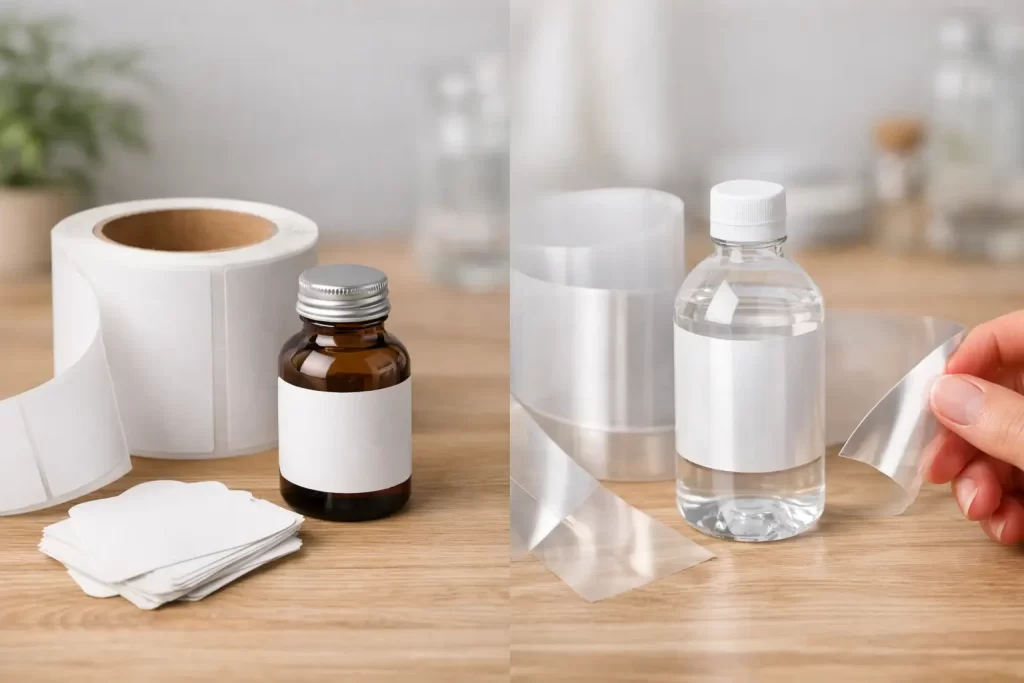
A label that looks excellent on press can still fail on the shelf, in the warehouse, or on a chilled production line. That is why the choice between paper labels vs film labels is not a design decision alone. For procurement teams, packaging managers, and brand owners, it is a material decision that affects durability, compliance, application efficiency, and total packaging performance.
In most commercial environments, the wrong label stock creates avoidable cost. It can wrinkle on curved containers, absorb moisture in cold-chain handling, scuff during transport, or lose shelf appeal before the product reaches the end user. The right choice supports both brand presentation and operational reliability. That is where understanding the difference between paper and film becomes valuable.
Paper labels vs film labels: the real difference
At a basic level, paper labels are made from paper-based facestocks, while film labels use synthetic materials such as polypropylene, polyethylene, or polyester. That sounds straightforward, but the practical implications are significant.
Paper labels are often selected for their print friendliness, tactile feel, and cost efficiency. They can deliver a premium visual result, especially for dry-use products, cartons, jars, and containers that are not exposed to heavy abrasion or moisture. They are also widely used when brands want a more natural or traditional appearance.
Film labels are engineered for performance in tougher conditions. They offer stronger resistance to water, oil, chemicals, tearing, and scuffing. They are often the better fit for squeezable containers, refrigerated products, personal care packaging, household chemicals, industrial containers, and applications where labels must remain intact through handling stress.
The decision is rarely about which material is better in absolute terms. It is about which material performs better for the product, the environment, and the production process.
When paper labels make the most sense
Paper labels remain a strong choice across many packaging formats because they balance visual quality and cost well. For dry goods, retail packaging, promotional labels, and many FMCG applications, paper can provide exactly the level of performance required without overengineering the solution.
One major advantage is print appearance. Paper surfaces often accept inks well and can deliver sharp graphics, strong text clarity, and decorative finishes that support premium branding. If your label needs a classic look, a matte texture, or a more organic visual identity, paper may align better with the brand than a synthetic film.
Paper labels also tend to be more economical than film options, particularly for high-volume applications where the package does not face demanding environmental conditions. For procurement teams managing cost across multiple SKUs, this can make a measurable difference.
That said, paper has limits. Moisture is the most obvious one. In chilled storage, condensation-prone transport, or wet application environments, paper can lose its appearance quickly. It may wrinkle, edge lift, or show wear faster than film. Even with coatings and laminations, paper generally does not match film for toughness.
For products sold in stable, dry environments, those limits may not matter. For products moving through cold supply chains or rough logistics channels, they usually do.
Typical paper label applications
Paper labels are commonly used for dry food packaging, pharmaceutical cartons, retail stickers, warehouse identification in controlled settings, and promotional or short-term labeling. They are also a practical choice where shelf appeal matters but extreme durability does not.
In these applications, paper provides a dependable balance of aesthetics, convertibility, and budget control.
When film labels are the better investment
Film labels are built for endurance. If the product will be squeezed, refrigerated, exposed to humidity, handled frequently, or stored in environments where abrasion is likely, film usually delivers better lifecycle performance.
Polypropylene films are widely used for premium consumer packaging because they combine good printability with moisture resistance and a clean, no-label look. Polyethylene is especially useful for flexible or squeezable containers because it conforms better to shape changes. Polyester is often selected for more demanding industrial or technical uses that require higher heat resistance or dimensional stability.
From a brand perspective, film labels can maintain a fresh appearance longer. They resist scuffing in transit, remain legible under demanding conditions, and support specialty finishes that create a strong shelf impression. For operations teams, they also reduce the risk of failure in production and distribution.
This matters in sectors such as home care, health and beauty, chemicals, beverage packaging, and logistics. A label that smears, tears, or lifts is not just a cosmetic issue. It can disrupt traceability, create compliance concerns, and undermine confidence in the product.
The trade-off is cost. Film labels generally come at a higher material price than paper. But if paper fails in use and requires relabeling, product write-offs, or customer complaints handling, the lower upfront cost may not hold up as the lower total cost.
Performance factors buyers should evaluate
The best label material choice comes from the application, not assumption. Several factors should be reviewed before specifying paper or film.
Environmental exposure is usually first. If labels will face water, condensation, oil, chemicals, freezer conditions, or outdoor use, film has a clear advantage. If exposure is limited and the package stays dry, paper may perform perfectly well.
Container surface and shape also matter. Rigid flat containers are easier for both materials. Curved, squeezable, or textured surfaces often favor film, especially where conformability is important.
Application method should not be overlooked. High-speed automated application requires consistent material behavior. Some packages, adhesives, and line speeds respond better to one facestock than another. A material that looks right in a sample room can still create dispensing or adhesion issues on a live production line.
Print requirements are another key consideration. Both paper and film can produce excellent graphics, but the finish, opacity, texture, and visual effect differ. If the goal is a premium crafted look, paper may be attractive. If the goal is durability with a polished, modern appearance, film often performs better.
Then there is compliance. In healthcare, chemical, logistics, and industrial sectors, label legibility is critical. Barcodes, variable data, warning information, and batch details need to remain readable throughout the product journey. In many cases, that pushes the decision toward film.
Paper labels vs film labels in sustainability discussions
Sustainability is often treated too simply in label selection. Paper is frequently assumed to be the more sustainable option, but the right answer depends on the full packaging system.
Paper can support sustainability goals where the application suits it, particularly when brands want a fiber-based presentation and the label does not need high-performance synthetic properties. But if a paper label fails early and causes waste, replacement, or damaged product presentation, that weakens the sustainability case.
Film labels can contribute to packaging efficiency in other ways. Lightweight construction, durability, and compatibility with certain container types may support overall packaging performance. In some applications, a well-specified film label reduces waste by lasting through the full supply chain without failure.
The better question is not which material sounds more sustainable. It is which material supports the intended package design, use conditions, and waste reduction goals most effectively.
How to choose the right label material for your product
A practical specification process starts with three questions. Where will the product go, what will the label face, and how long must it perform? Those answers usually narrow the material choice quickly.
If the product is dry, shelf-stable, and sold in a controlled environment, paper may be the efficient and commercially sound option. If the product faces cold storage, moisture, frequent handling, or a flexible container format, film is often the safer choice.
For many businesses, the smart move is to test materials against actual operating conditions instead of selecting on price alone. Trial runs can reveal how labels behave on applicators, how they respond to transport friction, and how well they preserve barcode readability and brand presentation. This is where an experienced manufacturing partner adds value – not by offering a generic answer, but by matching material, adhesive, print process, and end-use demands precisely.
At Kimoha, that material-first approach is what helps enterprise buyers reduce risk while protecting both product identity and packaging efficiency.
A strong label should do more than carry a logo. It should hold its place, stay readable, and support the product exactly where it is sold, shipped, and used. When that is the standard, the choice between paper and film becomes much clearer.
