


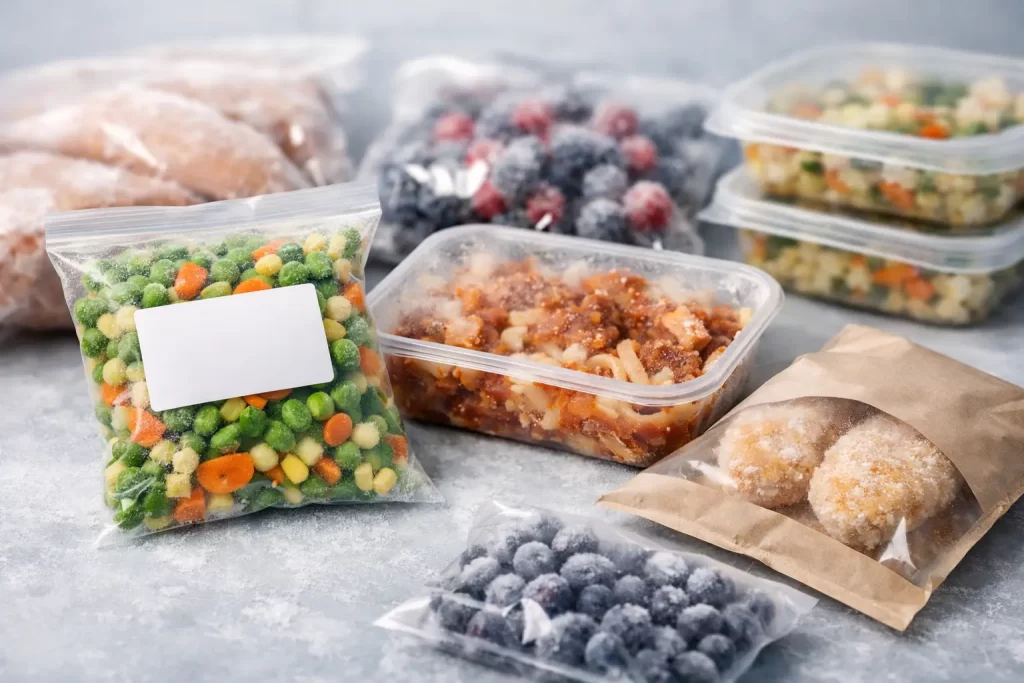
A frozen label that looks perfect on the production floor can fail within hours in storage. Adhesive lifts at the corners, print loses contrast, condensation clouds the surface, and suddenly a simple packaging component becomes a product risk. That is why choosing the best labels for frozen food packaging is less about appearance alone and more about performance under cold-chain pressure.
For food manufacturers, brand owners, and procurement teams, the label has to do several jobs at once. It must stay attached through freezing, handling, transport, and retail display. It must protect legibility for barcodes, batch data, ingredients, and compliance information. It also has to support shelf impact in a category where packaging is often exposed to moisture, abrasion, and rapid temperature shifts. The right label construction is not one material or one adhesive for every application. It depends on pack type, application temperature, storage conditions, and print requirements.
What makes the best labels for frozen food packaging
Frozen food packaging creates a harsher environment than many buyers first expect. Low temperatures affect adhesive flow and bond strength. Moisture from condensation can interfere with application and long-term adhesion. Flexible films, corrugated outers, rigid plastic containers, and pouches all behave differently under stress. A label that performs well on a dry bottle at room temperature may fail on a frozen pouch filled on a high-speed line.
The best labels for frozen food packaging are typically defined by five performance factors: adhesive suitability, facestock durability, print stability, compatibility with the packaging substrate, and regulatory readability. If one of these is overlooked, the label may still pass an initial test but fail in real distribution.
Adhesive performance matters first
In frozen applications, adhesive selection is often the deciding factor. Standard permanent adhesives may not develop a strong bond if labels are applied in very cold conditions or onto surfaces with slight moisture. Freezer-grade adhesives are formulated to perform at lower application and service temperatures, but even here, there are trade-offs.
Some adhesives are designed for labels applied before the product enters the freezer. Others are built for application in chilled or frozen environments where the label must bond quickly despite reduced tack. If your operation labels packs before blast freezing, you may have more flexibility. If labels are applied after freezing or in a cold room, adhesive choice becomes much narrower and more technical.
Rubber-based freezer adhesives often provide aggressive initial tack and can perform well on difficult surfaces, including some corrugated and low-energy plastics. Acrylic adhesives may offer better clarity, aging, and chemical resistance, but performance depends heavily on formulation. The right answer is rarely generic. It depends on whether the package is a rigid tray, flexible pouch, carton, or shrink-wrapped multipack.
Face materials must resist moisture and abrasion
Paper labels can work in some frozen applications, especially where cost control is central and the label is protected by secondary packaging. But paper is more vulnerable to tearing, edge wear, and moisture-related degradation. For many frozen food SKUs, filmic materials such as polypropylene or polyethylene offer stronger long-term performance.
Film labels resist water better, hold print quality more consistently, and tolerate handling stress across storage and transport. They are especially effective on flexible packs where bending and expansion can cause stiffer materials to lift or crack. That said, films usually come at a higher material cost, so they should be specified where the risk justifies the investment.
Matte and gloss finishes also matter. A gloss surface may enhance visual appeal for retail-facing packs, while a matte finish can improve readability and reduce glare for operational labeling. The best choice depends on whether branding, scanning accuracy, or both take priority.
Matching label construction to pack format
Frozen food packaging is not a single category. A label for a polyethylene bag of vegetables does not face the same conditions as a label for an ice cream tub or a frozen ready-meal tray.
Flexible pouches and bags
Flexible packaging often presents one of the more demanding label surfaces. It can wrinkle, compress, and change shape through filling and freezing. In these cases, conformable film labels with freezer-grade adhesive generally outperform more rigid constructions. If the pack surface has low surface energy, material compatibility testing becomes essential.
Rigid tubs, trays, and containers
Rigid plastic containers usually provide a more stable application surface, but they still require attention to condensation, texture, and curvature. Labels for frozen tubs and trays should maintain edge adhesion and print integrity despite stacking, rubbing, and low-temperature storage. If the pack is consumer-facing, scuff resistance becomes especially important.
Cartons and corrugated cases
Secondary and transit packaging in frozen environments often uses paper-based labels on cartons or corrugated outers. These can work well if the adhesive is designed for fiber surfaces in cold storage. However, corrugated can absorb moisture and present uneven surfaces, so not every standard logistics label will hold up reliably in freezer conditions.
Print durability is as important as adhesion
A label that stays attached but loses readability is still a failed label. Frozen food packaging often carries critical information such as nutrition data, expiration dates, lot codes, and barcodes. Print must remain sharp despite low temperatures, condensation, and friction during handling.
Thermal transfer, flexographic, and digital print methods can all be used effectively, but the material and ink system must be aligned. Smudging, ribbon mismatch, and poor ink anchorage are common issues when print specifications are treated as secondary. For branded packs, color consistency also matters. A premium frozen product cannot afford branding drift between batches or plants.
Protective coatings or laminates can add durability, especially where labels face abrasion or repeated contact in supply chains. This adds cost, but it can prevent expensive downstream problems such as scan failures, rejected shipments, or reduced shelf presentation.
Compliance and traceability cannot be an afterthought
In frozen food, labeling is tied directly to compliance and operational control. Ingredient declarations, allergens, batch data, storage instructions, and barcode readability all need to remain intact from packing to point of sale. If labels degrade in storage, the issue is not cosmetic. It can affect traceability, recalls, and retailer acceptance.
For manufacturers managing high-volume production, consistency matters as much as specification. The best-performing label is only valuable if it can be supplied with repeatable quality across runs, locations, and seasonal demand spikes. That is where a manufacturing partner with process control, material expertise, and quality discipline becomes critical.
Smart labeling can add value in some operations
Not every frozen food application requires advanced tracking, but some do benefit from it. RFID-enabled smart labels can support warehouse visibility, pallet tracking, and cold-chain inventory accuracy in larger operations. They are not the default choice for every frozen SKU because cost and infrastructure requirements vary. Still, for complex supply chains or high-value inventory movement, they can offer measurable operational advantages.
How to choose the right frozen food label supplier
The strongest label specification can still underperform if the supplier does not understand the application in real production conditions. Frozen food labeling should be engineered around use case, not chosen from a generic catalog.
A dependable supplier will ask the right questions early: What substrate is being labeled? At what temperature is the label applied? Is the package dry, chilled, or frozen at application? What are the storage and transport conditions? Does the label need to survive condensation, abrasion, or direct consumer handling? What print technology and compliance data are involved?
This level of technical review helps avoid a common procurement mistake – selecting labels by unit cost alone. A lower-cost label that fails in storage, causes line stoppages, or creates relabeling work is rarely economical. Total performance is the better benchmark.
For enterprise buyers, scale and consistency matter too. Suppliers should be able to support qualification, trialing, and repeat production with controlled quality. Companies such as Kimoha, with deep industrial labeling experience and broad converting capability, are positioned to support these more demanding requirements because they can align material selection, print quality, and production reliability around the actual application.
The best labels for frozen food packaging are tested, not assumed
There is no universal best label for every frozen food product. The right solution depends on the full packaging environment – substrate, temperature, moisture exposure, handling intensity, branding needs, and compliance requirements. Filmic labels may be the right answer for one product line, while a well-specified paper construction may be more efficient for another. One adhesive may perform well when labels are applied before freezing, while another is necessary for cold-room application.
The practical way forward is straightforward. Start with the application conditions, build the label from the adhesive up, and validate it through real-world testing rather than desk assumptions. In frozen food packaging, that discipline protects more than label performance. It protects brand presentation, operational continuity, and the trust built into every pack.
