


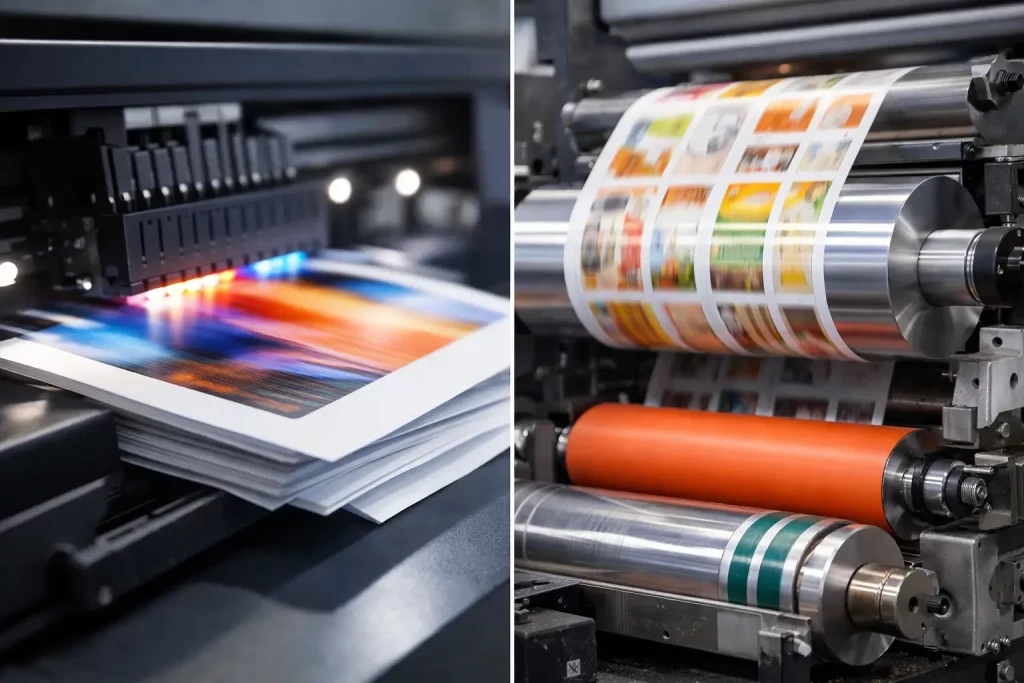
A label decision can affect far more than shelf appeal. It shapes lead times, cost per unit, version control, compliance accuracy, and how easily your packaging program can scale across SKUs and markets. That is why the choice between digital printing vs flexographic printing deserves a practical, production-focused evaluation rather than a simple quality comparison.
For procurement teams, brand managers, and operations leaders, the real question is not which process is better in general. It is which process fits your product mix, order volume, artwork variability, substrate needs, and delivery requirements. Both technologies are proven. Both can produce excellent results. The right choice depends on what your business is trying to achieve.
Digital printing vs flexographic printing: the core difference
Digital printing applies artwork directly from a digital file to the substrate without the need for printing plates. This allows faster job changes, shorter setup times, and greater flexibility for variable data, versioning, and short-run production. If your business regularly updates designs, runs seasonal promotions, or manages multiple SKUs in limited quantities, digital can be highly efficient.
Flexographic printing uses flexible relief plates and is engineered for high-speed, repeatable production over long runs. Once the job is set up, flexo delivers strong unit economics, consistent color output, and wide substrate compatibility. For brands with stable artwork, large order volumes, and demanding production schedules, flexographic printing remains a highly effective manufacturing solution.
The difference is not just technical. It changes how you plan inventory, approve artwork, manage waste, and respond to market changes.
When digital printing makes more sense
Digital printing is typically the stronger option when agility matters more than maximum economies of scale. Because there are no plates to produce, artwork can be revised quickly and jobs can move into production with less preparation. That is a practical advantage for companies launching new products, testing regional variants, or managing compliance changes.
This is especially relevant in sectors where packaging content shifts frequently. Healthcare, food and beverage, specialty retail, and logistics programs often require version control, serialized information, or shorter batch sizes. In these cases, digital printing supports operational flexibility without forcing buyers into oversized minimum order quantities.
Another major advantage is reduced setup waste. If you are producing short to medium runs, the lower makeready requirement can help control material usage and overall job cost. That matters when premium substrates are involved or when sustainability goals are part of the procurement decision.
Digital also performs well when visual complexity is high. Fine details, image-heavy graphics, and multiple design versions can often be handled more efficiently in a digital workflow, particularly when speed to market is a priority.
When flexographic printing is the better fit
Flexographic printing becomes increasingly cost-effective as volume rises. The initial setup includes plate production and press preparation, but once the job is running, the process is built for output, repeatability, and speed. That makes flexo a strong choice for established SKUs with predictable demand.
For many FMCG, home care, automotive, and industrial labeling programs, this matters more than setup convenience. If your packaging artwork is stable and annual volumes are high, flexographic production often delivers a lower cost per label over time. It also supports consistent replenishment for businesses that cannot afford disruption across production lines or distribution networks.
Flexo is also valued for its versatility across substrates and finishing requirements. Depending on the application, it can be well suited for pressure-sensitive labels, shrink sleeves, flexible packaging components, and specialty constructions that require durability, adhesive performance, or resistance to moisture, chemicals, and abrasion.
There is also a broader production consideration. Flexographic printing is often integrated into converting environments where laminating, varnishing, die-cutting, embellishment, and inline finishing are essential. For labels that need both visual impact and demanding functional performance, flexo offers dependable manufacturing strength.
Cost is not just about the quoted price
Buyers often approach digital printing vs flexographic printing through the lens of immediate unit cost. That is understandable, but not sufficient. The better comparison looks at total operational cost.
Digital printing usually has the advantage in shorter runs because it avoids plate costs and reduces setup time. It also lowers the risk of ordering more labels than needed simply to justify traditional production economics. If your products change frequently, excess inventory can become a hidden cost through obsolescence, redesigns, or regulatory updates.
Flexographic printing usually wins on long-run cost efficiency. Once setup is absorbed across larger volumes, unit pricing can become very competitive. For brands with high-throughput products and repeat orders, this can deliver strong savings over time.
The trade-off is straightforward. Digital helps reduce waste, improve responsiveness, and support shorter runs. Flexo helps maximize scale and lower per-unit cost on stable, high-volume programs. The right decision depends on whether your business is trying to optimize flexibility or throughput.
Print quality, brand consistency, and compliance
Both digital and flexographic printing can achieve high-quality results, but quality should be measured against the application, not just the sample sheet.
Digital printing is often favored for sharp imaging, smooth tonal transitions, and easy management of multiple artwork versions. It is useful when brands want to personalize packaging, localize content, or produce many SKUs with distinct graphics. If version accuracy is critical, digital workflows can simplify control.
Flexographic printing has advanced significantly and delivers excellent print performance, especially for large-volume label production where brand consistency matters across repeated runs. Modern flexo can achieve strong color control and dependable reproduction, particularly when managed by experienced operators and disciplined quality systems.
For regulated sectors, the conversation goes beyond appearance. Legibility, barcode readability, adhesive compatibility, substrate suitability, and resistance to handling conditions are often more important than theoretical print capability. A visually attractive label that fails in transit, storage, or application is a costly mistake. Process selection should always account for end-use performance.
Speed, lead times, and supply chain planning
Digital printing can shorten lead times because there is less prepress preparation. That speed is valuable for urgent launches, promotional campaigns, late-stage artwork changes, and lower-volume replenishment. It gives procurement and marketing teams more room to adapt without restarting an extended setup cycle.
Flexographic printing can offer exceptional production speed once the job is set and approved. For planned, recurring, high-volume orders, this supports steady supply and efficient scheduling. If your business runs frequent repeat jobs and values throughput consistency, flexo aligns well with structured procurement planning.
This is where many decisions are made. If your packaging environment is dynamic, digital often improves responsiveness. If it is stable and forecast-driven, flexo can improve production efficiency.
Which printing method is right for your labels?
The answer usually comes down to four operational factors: run length, artwork variability, substrate requirements, and turnaround expectations.
If you produce many SKUs in shorter quantities, digital printing often provides better control. If you produce fewer SKUs in large and repeatable volumes, flexographic printing is usually the stronger commercial choice. If your labels include variable information, promotional changes, or region-specific content, digital gains an advantage. If your labels need long-run consistency across demanding materials and finishes, flexo is hard to overlook.
In practice, many enterprise labeling programs benefit from both. A manufacturer may use flexographic printing for core, high-volume product lines and digital printing for limited editions, test launches, seasonal campaigns, or SKU extensions. That hybrid strategy can reduce waste, improve speed, and preserve cost efficiency where volume justifies it.
For companies managing complex packaging portfolios, the most effective printing partner is not one that pushes a single method. It is one that understands when each process creates the best technical and commercial outcome.
A smarter way to evaluate digital printing vs flexographic printing
Instead of asking which technology is superior, ask which one supports your operational reality. Are your SKUs growing? Do your labels change often? Are compliance updates frequent? Is excess label inventory becoming expensive? Or is your priority to secure reliable, high-volume output with tight unit economics and consistent brand presentation?
Those answers will guide the print decision more accurately than any broad claim about quality or speed. The best labeling programs are built around fit, not preference.
At Kimoha, that is how print technology should be evaluated – through application needs, production efficiency, and long-term brand performance. When the printing method matches the business requirement, labels do more than look right. They support procurement discipline, operational continuity, and stronger execution in the market.
The smartest print choice is usually the one that solves tomorrow’s production problems before they reach your packaging line.
