


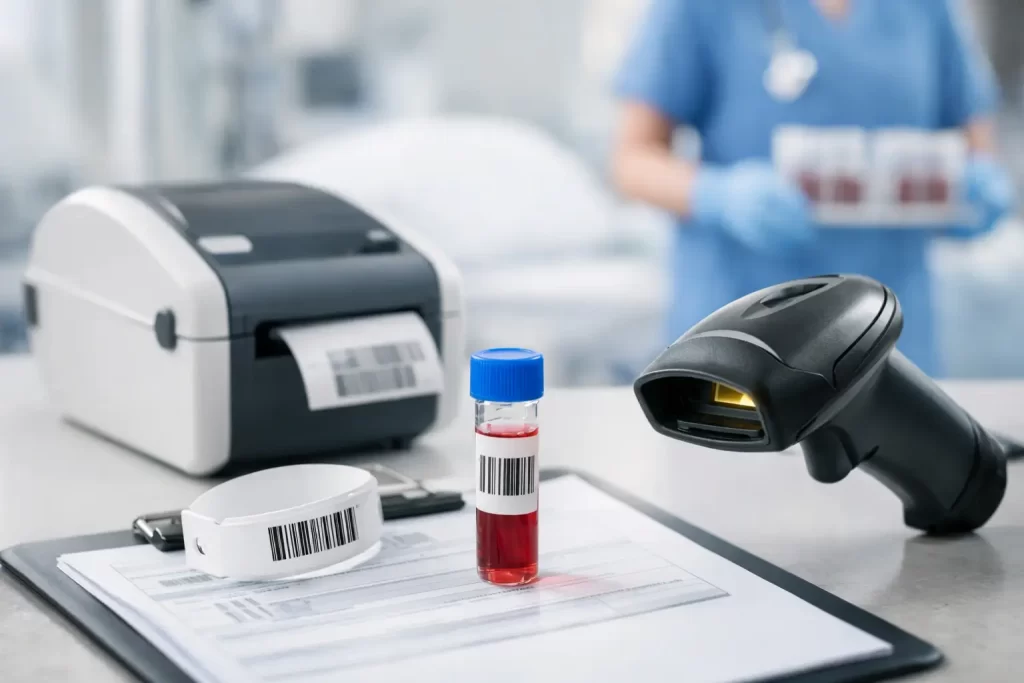
A mislabeled specimen, an unreadable wristband, or a medication package with a damaged barcode can create immediate operational risk. That is why healthcare barcode labeling systems are not just a packaging detail. They are a control point for patient safety, inventory visibility, regulatory compliance, and day-to-day workflow reliability.
For healthcare providers, laboratories, pharmaceutical manufacturers, and medical supply operations, barcode labeling has to perform in real conditions. Labels may be exposed to refrigeration, sterilization, moisture, abrasion, chemicals, frequent handling, and long storage cycles. If the print fades, the adhesive fails, or the barcode does not scan on the first attempt, the cost is measured in delays, rework, and avoidable risk.
What healthcare barcode labeling systems need to achieve
In healthcare environments, a barcode label carries more responsibility than simple identification. It often connects a physical item to a digital record, whether that item is a patient wristband, blood bag, medication vial, specimen container, asset tag, or sterile instrument tray. The label must support fast and accurate scanning while remaining legible throughout the item’s full use cycle.
That requirement changes the conversation from basic print supply to system performance. The label material, adhesive, print technology, barcode symbology, data structure, and application method all have to work together. A well-designed system reduces manual entry, limits identification errors, improves traceability, and supports audit readiness. A poorly designed one usually fails at the exact point where reliability matters most.
Healthcare organizations also operate across varied environments. A hospital pharmacy, a diagnostic lab, and a medical device manufacturer do not need the exact same label construction. The core objective is shared, but the performance demands are different. This is where many purchasing decisions become more complex than they appear at first.
Where healthcare barcode labeling systems are used
The most visible use case is patient identification. Wristbands need clear print, secure adhesion, and resistance to water, disinfectants, and daily wear. Scanning has to be quick and consistent because clinical staff do not have time to struggle with damaged or low-contrast codes.
Specimen labeling is equally critical. Tubes, slides, and sample containers often move through cold storage, transport, centrifugation, and lab processing. Labels in this setting need excellent adhesion to curved or small-diameter surfaces, along with print stability that can withstand temperature changes and handling.
Medication packaging introduces another set of requirements. Unit-dose packages, syringes, vials, and cartons may need high-resolution barcodes, lot and batch data, expiration dates, and variable information. In pharmaceutical and healthcare packaging lines, consistency matters at production speed, not only in small test batches.
Asset tracking is another growing area. Hospitals and healthcare networks increasingly use barcode labels to manage equipment, consumables, and reusable devices. Here, durability becomes central. The label must remain attached and scannable over repeated movement, cleaning, and service cycles.
Material and adhesive choices matter more than many buyers expect
A barcode is only as reliable as the label construction behind it. In healthcare, the wrong material choice can undermine an otherwise well-designed identification process.
Paper labels may work for short-life applications in dry, controlled settings, but they are rarely the best fit for items exposed to friction, moisture, or chemicals. Film-based materials often provide better resistance and dimensional stability, especially for clinical, laboratory, and pharmaceutical use. The trade-off is cost, but in regulated environments the lower failure rate often justifies the investment.
Adhesive selection is just as important. Surfaces in healthcare are not uniform. Labels may be applied to plastic containers, glass vials, corrugated packaging, foil pouches, or curved wristbands. Some surfaces are cold at the time of application. Others are sterilized later. A general-purpose adhesive may perform well in one application and fail completely in another.
This is why specification should begin with the use case, not with unit price alone. A lower-cost label that lifts, wrinkles, or becomes unreadable creates hidden operational expense. Re-labeling, product hold-ups, scan failures, and compliance exposure can quickly outweigh any initial savings.
Print quality is not a cosmetic issue
In healthcare barcode labeling systems, print clarity is a functional requirement. Barcodes must scan easily under real operating conditions, including high-volume workflows, different scanner types, and varied lighting environments. Small inconsistencies in contrast, edge definition, or quiet zones can affect readability.
This becomes even more important when labels include variable data such as serial numbers, lot codes, dates, or patient-specific information. If printing is not tightly controlled, one label roll may perform differently from the next. For procurement and operations teams, consistency across runs is often more valuable than isolated print quality on a sample sheet.
The best results usually come from matching the print process to the application. Flexographic production can deliver strong performance for scale and consistency, while digital printing can support variable data and shorter runs with speed and flexibility. In many healthcare settings, the right answer depends on volume, regulatory needs, and how frequently information changes.
Compliance, traceability, and scan accuracy
Healthcare operations are built on documentation and verification. Barcode labeling supports both. When labels are designed correctly, they create an efficient bridge between physical inventory and electronic systems. That improves traceability across receiving, storage, dispensing, administration, testing, and returns.
The compliance value is significant. Labels can help support product identification, batch tracking, expiration management, and chain-of-custody controls. They also reduce dependence on handwritten or manually entered information, which is where many avoidable errors begin.
Still, traceability is only as strong as scan accuracy. If staff have to key in data because a barcode will not scan, the control breaks down. That is why verification should be part of the labeling process from the beginning. Barcode grade, print repeatability, and real-world testing should be treated as operational safeguards, not optional extras.
How to evaluate a healthcare barcode labeling system
The right evaluation starts with the full journey of the label. Buyers should ask where the label will be applied, what surface it will adhere to, how long it must last, what conditions it will face, and which scanners or systems will read it. This sounds basic, but many failures happen because the specification only reflects one stage of use.
It also helps to separate must-have performance criteria from preferences. A label for frozen specimen storage needs cold-temperature adhesion and print durability. A patient wristband needs comfort, readability, and resistance to soaps and sanitizers. A pharmaceutical carton may need brand presentation as well as barcode compliance. These are different problems, and they should not be solved with one generic construction.
Supplier capability should be part of the evaluation too. In healthcare, a label manufacturer is not simply delivering printed stock. The supplier should be able to advise on material compatibility, barcode performance, print process selection, and production consistency. For larger healthcare groups and regional operations, dependable lead times and quality control are just as important as technical fit.
Why a tailored approach outperforms a standard one
Standard labels have a place, especially for simpler internal applications. But as healthcare operations become more traceability-driven, tailored labeling systems usually deliver stronger long-term value. They reduce failure points, support process accuracy, and align more closely with the realities of regulated environments.
That tailored approach may include custom sizing, specific adhesives, high-durability facestocks, variable data capability, tamper-evident features, or integration with RFID for broader asset visibility. Not every application requires all of that. The point is precision. The label should match the operational demand instead of forcing the operation to adapt around label limitations.
This is where an experienced manufacturing partner adds measurable value. Companies like Kimoha, with deep industrial label expertise and advanced print capability, can help healthcare buyers move beyond commodity thinking and specify labels that are built for performance, compliance, and scale.
Healthcare teams already have enough variables to manage. Barcode labels should remove uncertainty, not introduce it. When the system is designed well, it supports faster decisions, cleaner workflows, and safer outcomes without demanding attention every time someone picks up a scanner.
The best healthcare barcode labeling systems do not call attention to themselves. They simply work, every time they are needed, in the environments where failure is not acceptable.
