














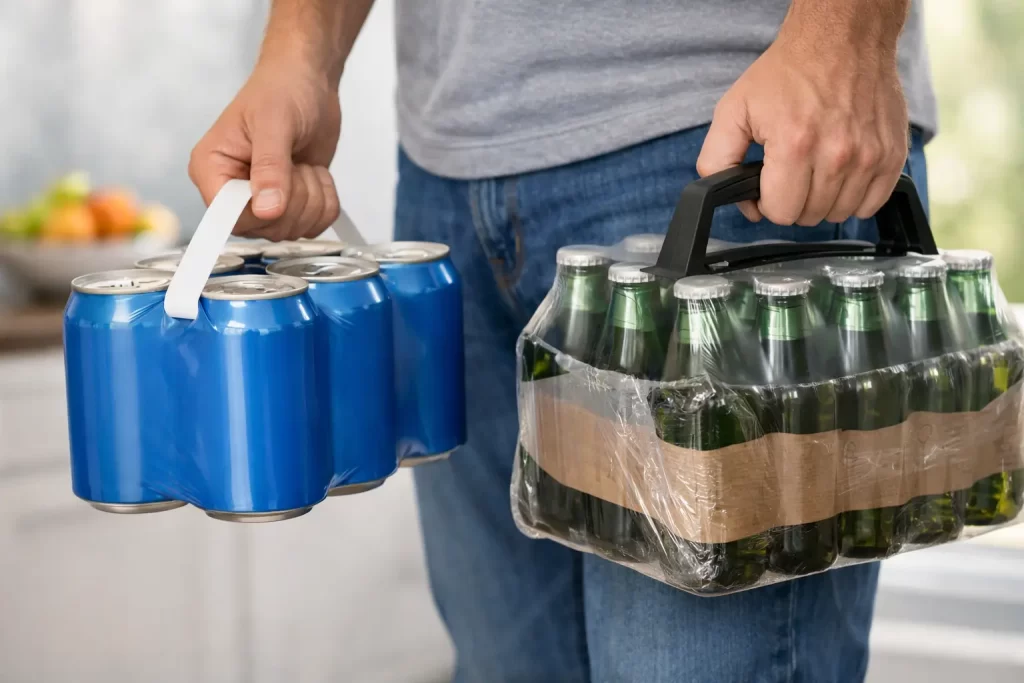
A beverage multipack can look perfect on the shelf and still fail at the moment that matters most – when a shopper lifts it. That is where carry handles for beverage packs stop being a minor packaging add-on and become a performance decision. If the handle cuts into the hand, tears under load, or slows line speeds, the pack creates friction for both the customer and the operation behind it.
For procurement teams, packaging engineers, and brand managers, the value of a carry handle is straightforward. It must hold weight reliably, fit the pack format, support brand presentation, and run consistently at production scale. Anything less becomes a quality issue, a cost issue, or both.
Why carry handles for beverage packs matter more than they seem
In beverage packaging, small components often carry outsize responsibility. A handle has to perform under real-world conditions that are rarely gentle. Packs are lifted from pallets, stacked in retail back rooms, loaded into carts, carried to cars, and stored at home. Moisture, condensation, cold-chain movement, and repeated handling all put stress on the same small touchpoint.
That makes handle design a cross-functional packaging choice. Operations teams care about application efficiency and load security. Brand teams care about presentation and customer experience. Procurement cares about consistency, waste reduction, and cost control. The right specification supports all three.
There is also a retail reality to consider. Beverage packs are often purchased in bulk, especially in water, juices, dairy drinks, and canned soft drinks. If the pack feels awkward or unstable to carry, it affects shopper perception quickly. Convenience is not just a consumer preference here. It is part of the product experience.
What a good beverage pack handle needs to do
The first requirement is obvious – it has to hold the intended load with a clear safety margin. But strength on paper is not the same as performance in use. Handle material, adhesive behavior, grip shape, and the way force is distributed across the pack all affect whether the solution works consistently.
Comfort matters more than many buyers expect. A narrow or poorly placed handle can feel harsh even if it technically supports the weight. For heavier multipacks, grip comfort influences whether customers perceive the pack as premium, practical, or frustrating. That is especially relevant for family-size beverage formats and warehouse retail packs.
The handle also needs to match the packaging substrate. A solution that performs well on shrink film may not behave the same way on corrugated or paperboard. Surface energy, pack contour, and environmental exposure all influence adhesion and long-term hold. This is why testing should reflect the actual pack structure, not just the product weight.
Then there is line compatibility. Some handle solutions are better suited to high-speed automated application, while others work for lower-volume or more specialized runs. Choosing the wrong format can introduce avoidable slowdowns, misapplication, or excess material waste.
Common formats and where each fits best
Carry handles for beverage packs are not one-size-fits-all. The right format depends on product weight, pack geometry, substrate, retail channel, and line configuration.
Adhesive carry handles are widely used for shrink-wrapped multipacks and bottled water packs. They are efficient, relatively lightweight, and can be engineered for strong hold when paired with the correct film and adhesive system. For high-volume FMCG environments, they offer a practical balance of function and application speed.
Die-cut integrated handles in paperboard cartons work well when the secondary pack itself is rigid enough to support lifting. This approach can simplify pack construction, but it depends heavily on board strength and structural design. If the carton is not reinforced properly, the handle area becomes a stress point.
Clip-on or added accessory handles may be suitable for specialty formats where the pack shape makes adhesive application less effective. These can help in premium, promotional, or irregular configurations, though they may increase component complexity.
Sustainable paper-based handle formats are also gaining attention as brands reassess plastic usage. They can support environmental goals, but they need careful engineering. Moisture exposure, fiber integrity, and pack weight all matter. In some cases, paper-based solutions are an excellent fit. In others, a hybrid or alternative material will deliver better real-world reliability.
The trade-offs buyers should evaluate early
The cheapest handle is rarely the lowest-cost option over time. If application accuracy drops, if pack failures increase in distribution, or if customer complaints rise, the total cost moves quickly in the wrong direction.
This is where trade-offs need to be discussed upfront. A thicker material may improve carrying comfort but affect material cost and applicator settings. A stronger adhesive may perform better in chilled conditions but require tighter control of substrate compatibility. A more premium printed handle can support shelf differentiation, but only if the branding remains consistent at production scale.
It also depends on where the product is sold. A convenience retail multipack has different handling demands than a club-store water bundle. E-commerce adds another layer because secondary handling stress tends to be higher. The best specification is usually the one designed around the full supply chain, not just the filling line.
Design details that influence performance
Small handle details often determine whether a pack performs well in market. Grip aperture size affects usability across different hand sizes. Placement angle affects how the pack balances during lifting. Handle length affects whether the product swings awkwardly or stays stable.
Load distribution is especially important for beverage packs with multiple bottles or cans. If the handle pulls force into a narrow area of film or board, tearing risk increases. Good design spreads the load more evenly and reduces stress concentration.
Print quality can also be part of the equation. For branded handles, registration, color consistency, and scuff resistance contribute to perceived product quality. This is not only a marketing concern. In crowded retail categories, the handle may be one of the few package elements touched directly by the customer before purchase.
For regulated or traceability-driven environments, additional information may need to coexist with branding without compromising readability or application performance. That balance requires manufacturing precision, not just creative design intent.
Testing carry handles for beverage packs the right way
Lab validation is useful, but controlled testing alone is not enough. Beverage packs should be tested in conditions that reflect actual production and distribution exposure. That includes cold storage, humidity, pallet stacking, transport vibration, and repeated lifting.
Application trials should assess more than bond strength. They should also confirm placement consistency, machine compatibility, reject rates, and the effect of speed changes across production runs. A handle that performs well in a short test window may behave differently in extended-volume manufacturing.
Field feedback matters too. Retail handling, warehouse movement, and shopper use reveal issues that line trials may miss. If failure happens only after condensation builds up or after a pack is carried for several minutes, that still counts as a packaging failure.
A strong supplier relationship helps here. The best outcomes usually come from collaborative specification, prototyping, and validation rather than selecting a generic handle format and hoping it fits.
Choosing a manufacturing partner, not just a component
For business buyers, consistency is the real benchmark. A handle sample can look excellent in isolation. The harder question is whether the supplier can maintain material quality, adhesive performance, print standards, and delivery reliability over repeated production cycles.
That is why manufacturing capability matters as much as the handle itself. Material control, print precision, QA discipline, and application knowledge all influence final pack performance. Beverage brands do not need packaging accessories that work only under ideal conditions. They need solutions that hold up across scale, seasonality, and operational pressure.
An experienced packaging partner should be able to advise on substrate compatibility, weight tolerance, branding opportunities, and sustainability pathways without losing sight of throughput and cost. That is where a company like Kimoha adds value – not simply by supplying components, but by aligning packaging performance with commercial requirements.
Where the category is moving
The next phase for beverage carry handles will be shaped by two forces: sustainability pressure and operational precision. Brands want material efficiency and lower environmental impact, but they cannot compromise pack security. At the same time, production teams need solutions that integrate cleanly into increasingly optimized packaging lines.
That points toward better-engineered substrates, smarter adhesive systems, and more exact application standards. It also points toward packaging decisions made earlier in the development cycle, when structure, graphics, logistics, and shopper use can be considered together.
A carry handle may be a small part of the pack, but it carries a large share of the experience. When it is specified well, customers barely notice it. They just trust the pack, lift it easily, and move on. For beverage brands, that quiet reliability is exactly the point.