
















A label failure rarely starts on the labeling line. It usually starts much earlier – in supplier selection.
For procurement teams, packaging managers, and brand owners, choosing a custom printed labels manufacturer is not a design decision alone. It is an operational decision with direct impact on compliance, shelf presence, production efficiency, and traceability. The right manufacturer helps a product move cleanly from press to application to end use. The wrong one creates avoidable waste, inconsistent branding, delayed launches, and performance issues in the field.
That is why the evaluation process needs to go beyond price per roll.
What a custom printed labels manufacturer should actually deliver
A strong manufacturing partner does more than print artwork. It should translate product requirements into label constructions that perform under real conditions, whether the application involves chilled beverages, pharmaceutical packaging, logistics cartons, retail SKUs, aviation tags, or high-speed FMCG lines.
That means understanding face stock, adhesive behavior, release liners, print method, finishing, regulatory demands, and how the label interacts with the package surface. A label that looks sharp in a sample review can still fail in production if it wrinkles on curved containers, loses adhesion in cold storage, or scans poorly in distribution.
A dependable custom printed labels manufacturer brings technical discipline to those variables. It should be able to recommend suitable materials, match brand colors consistently, maintain print registration, and produce at volumes that align with your forecast and replenishment cycle.
For B2B buyers, this is where supplier value becomes measurable. Good labels support uptime, compliance, and brand execution at the same time.
Print quality matters, but performance matters more
In competitive categories, visual impact matters. Labels carry brand identity, promotional messaging, mandatory declarations, batch data, and often security or tracking features. Crisp printing and color consistency are essential, especially when products are distributed across markets and retail environments where presentation affects perception.
Still, performance under use conditions matters just as much as aesthetics. A healthcare label may need strong legibility for variable information and resistance to handling. A home care product may need durability against chemicals or moisture. A logistics label may need barcode reliability throughout transport. A food and beverage application may require materials and adhesives suited to refrigeration, condensation, or squeezable packaging.
This is where buyer priorities often need balance. The lowest-cost option may meet visual expectations but fall short in application efficiency or durability. On the other hand, the most engineered specification is not always necessary for every SKU. The right manufacturer helps define fit-for-purpose performance instead of pushing generic stock solutions or overbuilt constructions.
How production capability affects consistency
Manufacturing capability has a direct effect on whether labels perform consistently across runs. Businesses scaling product volumes or managing multiple SKUs need more than occasional quality checks. They need repeatability.
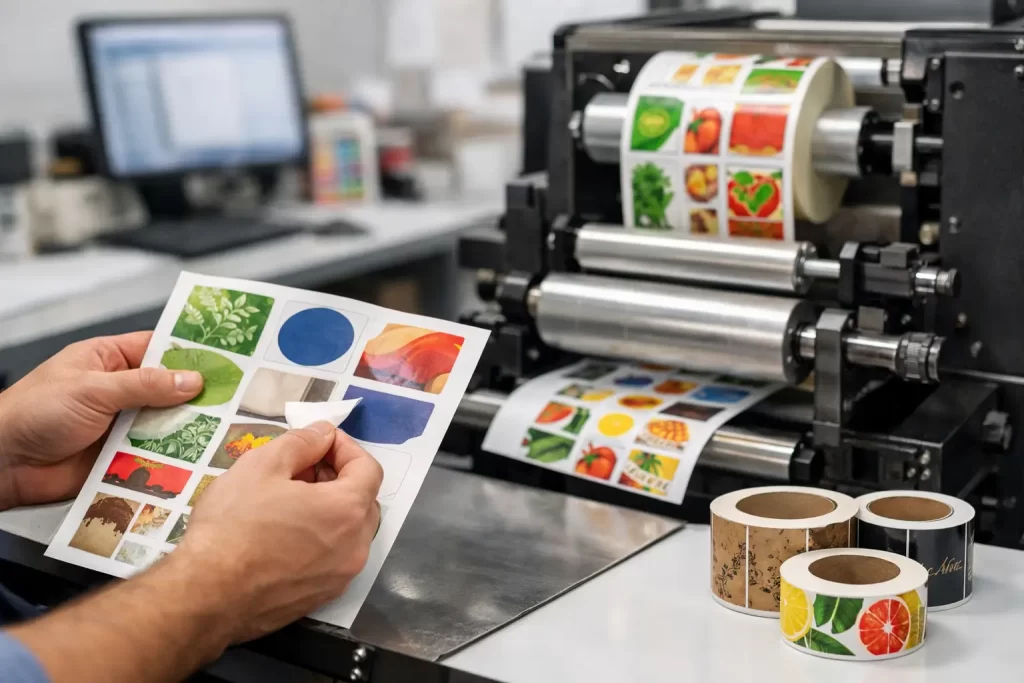
A manufacturer with advanced flexographic and digital printing capability can support different production needs more effectively. Flexographic printing is often a strong fit for long runs, stable repeat jobs, and cost-efficient volume production. Digital printing can offer agility for shorter runs, versioning, market tests, and faster artwork changes. For many enterprises, the value is not in one technology replacing the other. It is in having access to the right process for the job.
That flexibility becomes especially useful when procurement teams are managing a mix of standard product lines and fast-moving promotional or regional variants. A capable manufacturer can guide that mix without compromising lead times or print standards.
Finishing capability matters too. Lamination, varnishing, die-cut precision, sequential numbering, tamper features, and specialty constructions should be controlled within a quality-focused process, not treated as secondary add-ons.
Industry knowledge is not optional
Labels are regulated, handled, stored, and inspected differently across sectors. A supplier that understands one category well may still struggle in another.
For food and beverage, there may be requirements around moisture resistance, packaging compatibility, and high-volume line efficiency. In healthcare, readability, data integrity, and regulatory discipline are central. In logistics and warehousing, scan accuracy and adhesive stability across handling conditions are critical. Aviation and industrial applications may demand durable tags and specialized identification formats. Retail and consumer goods often require a careful blend of premium appearance, cost control, and launch responsiveness.
This is why category experience matters. A manufacturer with industry-specific knowledge can flag risks earlier, recommend suitable constructions faster, and reduce trial-and-error during qualification.
For buyers, this shortens decision cycles and lowers the chance of specification issues surfacing after production has already started.
Questions procurement teams should ask
When evaluating a custom printed labels manufacturer, the most useful questions are usually operational. Can the supplier maintain color consistency across repeat orders? How do they manage quality control and approval workflows? What testing is done for adhesion, print durability, and application performance? Can they support variable data, RFID integration, or security features if requirements expand later?
Lead time discipline is another critical point. Many label programs fail not because of print defects, but because replenishment timing does not match production schedules. A manufacturer should be able to align with ordering patterns, forecast cycles, and regional delivery needs.
It also helps to understand how the supplier handles change. If artwork updates, compliance text revisions, or packaging format changes are common in your business, responsiveness becomes part of quality. A reliable partner should adapt without creating confusion in version control or delays in dispatch.
Why innovation is becoming part of the core label brief
The definition of a label is expanding. Many businesses now expect labels to support more than identification and branding. They also need traceability, authentication, inventory visibility, and sustainability progress.
That is where capabilities such as RFID-enabled smart labels and security labels become commercially relevant. For some sectors, these are already operational tools rather than future-facing extras. RFID can improve asset tracking, warehouse visibility, and inventory management. Security labels can support anti-counterfeiting measures and tamper evidence. In regulated or high-value product environments, those functions contribute directly to control and trust.
Sustainability is similar. Buyers increasingly want packaging components that support broader environmental targets, but practical constraints still apply. Material selection, print process, recyclability considerations, and performance requirements have to be weighed together. A sustainable option that creates application issues or product loss is not always a better outcome. The right manufacturer approaches sustainability as an engineering and supply decision, not a marketing claim.
Regional service and scale still matter
For companies operating across the UAE, KSA, Oman, India, and nearby markets, regional supply capability can be a major advantage. Label requirements are often time-sensitive, especially when tied to production schedules, market launches, or compliance updates. A manufacturer with regional strength is better positioned to support continuity, faster coordination, and more dependable delivery planning.
Scale matters in a similar way. Enterprise buyers need confidence that a supplier can support growth, seasonal spikes, and multi-site requirements without sacrificing control. At the same time, large capacity alone is not enough. The manufacturer also needs the discipline to handle detail – from artwork accuracy to batch consistency to shipment readiness.
That combination of scale and control is what separates a vendor from a long-term manufacturing partner.
What strong partnerships look like in practice
The best label programs are built on shared clarity. Specifications are defined properly. Approval processes are structured. Quality expectations are documented. Communication moves quickly when changes happen. Problems are addressed at root cause, not patched over with reprints and short-term fixes.
A custom printed labels manufacturer should support that way of working. It should bring manufacturing knowledge into the conversation early, especially when a business is launching a new SKU, changing packaging materials, introducing smart labeling, or entering a new market.
This is where an experienced partner such as Kimoha can make a meaningful difference. With broad industrial label capabilities, advanced printing technologies, and a strong focus on quality-driven production, the value goes beyond output volume. It lies in helping business buyers make better labeling decisions from the start.
If your labels need to carry brand value, compliance demands, and operational performance all at once, supplier choice deserves the same rigor as any other critical packaging decision. The right manufacturing partner will not just print what you send. They will help your packaging system work harder, more accurately, and with fewer surprises.