


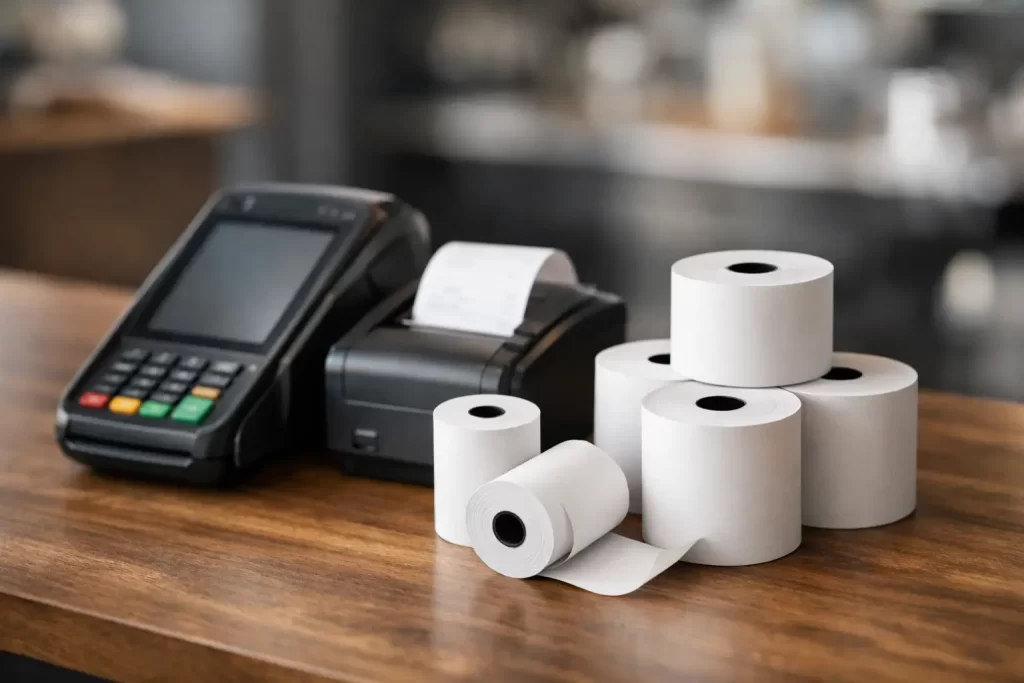
A receipt printer rarely gets attention until it slows a checkout line, creates unreadable records, or starts jamming during peak hours. That is why selecting the right paper rolls for POS machines is not a minor purchasing detail. For retailers, pharmacies, restaurants, logistics counters, and service businesses, it affects transaction speed, print clarity, record retention, and day-to-day operating reliability.
The mistake many businesses make is treating POS rolls as a generic consumable. They are not. Paper width, roll diameter, core size, thermal coating, image stability, and production consistency all influence how well a printer performs. If your business manages multiple outlets or high transaction volume, those variables quickly become procurement, maintenance, and customer experience issues.
Why paper rolls for POS machines matter more than expected
At the point of sale, paper performance is tied directly to operational efficiency. A roll that sheds excess dust can shorten printhead life. A roll with inconsistent winding can feed unevenly and trigger jams. A poor thermal coating can produce light or patchy text, which becomes a problem when customers need receipts for returns, accounting, warranty claims, or compliance records.
There is also a brand impact. Receipts may be small, but they are still customer-facing printed material. Clean output, readable text, scannable barcodes, and stable print quality support a more professional experience. For businesses that add promotional messages, return policies, or transaction details, print definition matters even more.
For procurement teams, the issue is broader than unit price. A lower-cost roll that causes more printer wear, more operator intervention, or more rejected transactions is not a lower-cost choice in practice. The better measure is total operating value over time.
The key specifications to check before ordering
The right roll starts with printer compatibility. POS printers are built for specific paper widths, and the most common sizes include 57 mm and 80 mm. Even a small mismatch creates feeding issues or poor print alignment. Roll diameter also matters because it determines how often rolls need replacement and whether the roll fits the printer housing correctly.
Core size is another detail that should not be overlooked. Some printers are more tolerant than others, but an incorrect core can affect fit and movement. For multi-site operations using different printer models, standardizing the correct specification by device type prevents avoidable supply errors.
Paper type is just as important. Most POS systems use thermal paper, which prints through heat rather than ink. That makes coating quality critical. A well-manufactured thermal surface delivers dark, sharp images with consistent sensitivity across the roll. In lower-grade paper, print density can vary from one section to another, leading to faded areas or incomplete text.
Length and grammage can also influence performance. Longer rolls reduce changeover frequency, which is useful in high-volume environments, but only if the diameter still suits the printer. Paper that is too thin may tear too easily, while paper that is too heavy may affect feed performance in some devices. The right balance depends on usage conditions and printer design.
Thermal paper quality and print durability
When businesses evaluate POS paper, print durability deserves close attention. Not every receipt needs long archival life, but many do need to remain legible for a practical retention period. Sectors such as retail, healthcare, hospitality, and logistics often rely on receipts for dispute resolution, returns, auditing, and internal tracking.
High-quality thermal paper helps preserve image clarity for longer under normal handling conditions. That said, thermal receipts are still sensitive to heat, friction, oils, and prolonged light exposure. If receipts are likely to be stored for records, exposed to warmer environments, or handled frequently, paper selection should reflect that use case.
This is where a specification-driven supplier relationship becomes valuable. Instead of buying by price alone, businesses can source rolls matched to print life expectations, equipment sensitivity, and operating conditions. That approach reduces rework and supports more predictable performance.
Common problems caused by poor-quality POS rolls
Many recurring printer issues are blamed on the machine when the paper is the real cause. Frequent jamming is one of the clearest examples. If the roll is wound unevenly or cut inconsistently, the printer feed system may struggle to maintain smooth motion. The result is downtime at the checkout counter.
Another common issue is excessive paper dust. Lower-quality paper can release fine particles during use, which accumulate on the printhead and internal components. Over time, that buildup affects print clarity and may increase maintenance requirements.
Faded output is also a warning sign. In some cases, the thermal coating is inconsistent. In others, the paper may not be properly matched to the printer’s heat settings. Either way, the business ends up with receipts that are difficult to read and harder to trust.
There is also the issue of barcode performance. If a receipt includes scannable elements for returns, loyalty programs, or logistics handoffs, weak print contrast can create scanning failures. That slows service and adds friction to otherwise simple transactions.
How to choose paper rolls for POS machines by industry use
Different industries use POS paper in different ways, so the best choice is not always the cheapest standard roll. A quick-service restaurant, for example, may prioritize fast print response, reliable feed, and frequent roll replacement efficiency. A pharmacy may place more emphasis on legibility and print stability because customers may keep receipts for reimbursement or reference.
In retail, barcode readability and clean branding are often priorities, especially when receipts include promotional content, store policies, or item-level detail. In logistics or service counters, receipts may function more like operational documents, where clarity and handling durability become more important.
Multi-location businesses should also think about consistency across sites. Standardized paper specifications simplify procurement, reduce branch-level errors, and help support teams troubleshoot more efficiently. When every site uses the right format for its installed printer base, operations become easier to manage.
Procurement considerations beyond price
For business buyers, reliable supply is as important as product quality. Running out of POS rolls can disrupt front-end operations immediately, so lead times, stocking plans, and production consistency should be part of the buying decision.
This is particularly relevant for enterprises that operate at scale or across multiple regions. A supplier should be able to deliver repeatable specifications, stable quality from batch to batch, and dependable fulfillment schedules. Variability in paper performance between shipments creates avoidable operational noise.
Customization may also be relevant. Some businesses require printed backs for terms, branding, or promotional messaging. Others may need packaging configurations suited to warehouse handling and store distribution. Working with a manufacturing partner that understands industrial print quality and production discipline can make a measurable difference. Companies such as Kimoha support this type of requirement with a quality-focused, application-led approach rather than a one-size-fits-all supply model.
Sustainability and compliance considerations
Sustainability is becoming a more practical procurement factor in paper products, including POS rolls. Businesses are under growing pressure to reduce waste, improve sourcing decisions, and align packaging and consumables with broader environmental goals.
That does not mean every operation needs the same specification. It does mean buyers should ask better questions about paper origin, production standards, and whether the selected material supports their internal sustainability targets. If receipts are used in large volumes, even small material improvements can have a meaningful cumulative effect.
Compliance may also matter, especially in regulated sectors where documentation quality and traceability are important. A dependable paper roll supplier should be able to provide specification clarity and maintain quality control that supports industrial purchasing standards.
What a good supplier should help you solve
A strong supplier does more than ship cartons of rolls. They help define the correct size, advise on thermal quality, maintain batch consistency, and reduce the risk of operational disruption. That support matters when procurement teams are balancing cost control with uptime, customer experience, and equipment longevity.
The best sourcing decisions are usually not about finding the lowest visible price. They are about reducing hidden costs – printer wear, wasted rolls, replacement frequency, poor print quality, and inconsistent supply. Over time, those factors have a much greater impact on operating efficiency than a small difference in unit cost.
Paper rolls may seem like a routine line item, but in active POS environments they influence more than most teams expect. When the specification is right, checkout stays fast, receipts stay readable, and equipment performs the way it should. That is the kind of detail that keeps operations moving without asking for attention.
