
















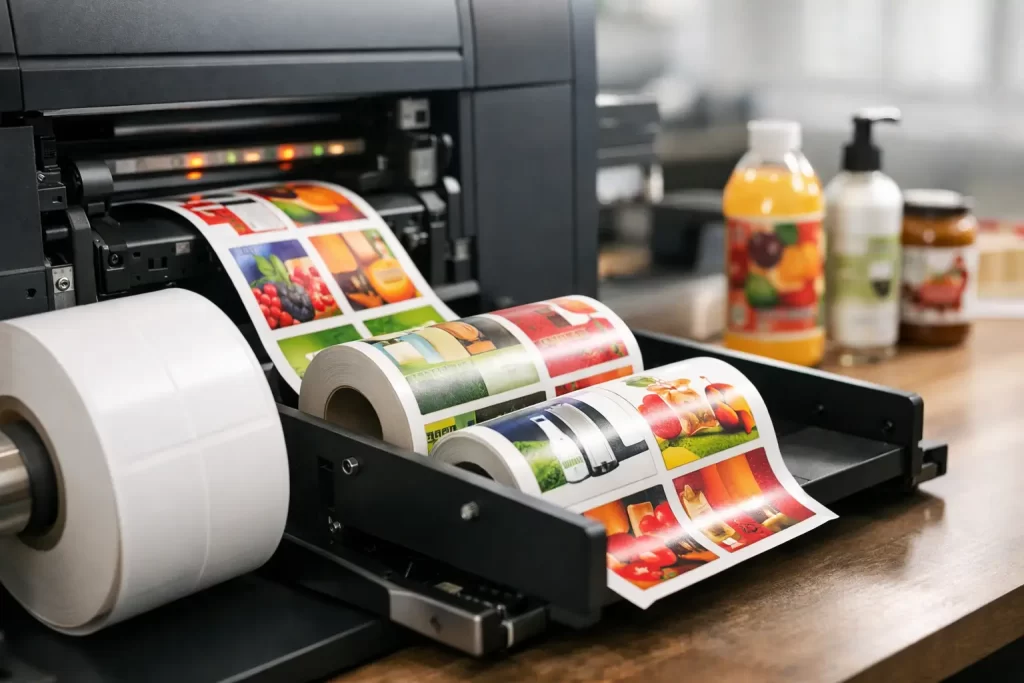
A delayed product launch rarely fails because of the product itself. More often, it stalls on packaging – revised ingredient panels, late-stage artwork changes, a market-specific SKU, or a test batch that does not justify long conventional print runs. That is exactly where digital label printing for short runs gives manufacturers and brand teams a practical advantage.
For businesses managing multiple SKUs, limited editions, compliance updates, or regional variations, short-run digital production offers control without forcing excess inventory. It reduces the gap between design approval and labeled product on the shelf, while keeping print quality, brand consistency, and operational flexibility intact.
Why digital label printing for short runs is growing
Shorter product cycles have changed label demand. FMCG brands launch seasonal variants faster. Food and beverage producers adjust packaging for promotions and regulatory updates. Healthcare and logistics operations need tighter traceability and variable data. In each of these cases, ordering large volumes of labels too early creates risk.
Traditional print methods still have a strong place in industrial labeling, especially when volumes are high and artwork remains stable over time. But short runs are different. Setup costs, plate creation, and long changeover times can make conventional methods less efficient when quantities are modest or versions change frequently.
Digital printing removes much of that friction. Because there is no need for plates, artwork can move into production faster. Version changes are easier to manage. Waste is lower at startup. For procurement and operations teams, that means better alignment between actual demand and label inventory.
This matters financially, but it also matters operationally. When a business can order what it needs, when it needs it, it avoids tying working capital to obsolete packaging stock.
What qualifies as a short run?
There is no single number that defines a short run across every sector. For one business, it may mean a few hundred labels for a pilot launch. For another, it may mean several thousand labels across multiple SKUs, languages, or pack sizes.
The better way to define a short run is by production logic rather than volume alone. If the label quantity is too low to justify plates and extended setup, if artwork is likely to change, or if multiple variants are required within a limited timeframe, digital production is often the better fit.
That is why short runs are common in product trials, promotional packaging, region-specific labels, compliance revisions, event-based branding, and premium or personalized editions. The volume may vary, but the business need is the same – flexibility without compromising print performance.
The operational advantages of digital label printing for short runs
The first advantage is speed. Digital workflows reduce prepress complexity, which helps approved artwork move into production faster. When timelines are tight, that can support launch schedules, replenishment cycles, and urgent market changes.
The second is version control. Businesses with multiple product variants often need labels that are nearly identical but not interchangeable. A flavor change, dosage detail, barcode update, or export-market regulation may affect only part of the design, but it still requires precision. Digital systems are well suited to managing these controlled variations with fewer production interruptions.
The third is inventory discipline. Ordering long runs for short-term needs often creates dead stock. If branding changes, regulations shift, or demand forecasts miss the mark, unused labels become waste. Short-run digital production helps businesses carry packaging inventory that reflects current requirements rather than best guesses made months in advance.
There is also a quality benefit. Modern digital presses produce strong color reproduction, clean text, and sharp graphics suitable for demanding brand applications. That makes them especially useful when shelf impact matters as much as functionality.
Where short-run digital labels make the most sense
Food and beverage brands often use short-run labels for seasonal packaging, promotional offers, limited flavors, and export-market variations. In these environments, speed and accurate versioning are essential because a small artwork error can delay distribution or create compliance issues.
Healthcare applications benefit when lot-specific information, cautionary details, or product updates need to be introduced quickly and accurately. In sectors where traceability matters, the ability to manage variable information with consistency becomes a real operational asset.
Retail and consumer goods companies frequently rely on short runs for market testing. Before committing to wider production, they may want to validate a new pack design, trial a premium line extension, or localize packaging for a particular channel. Digital printing supports that process without forcing unnecessary inventory.
Logistics and industrial users also gain value, especially when labels need functional performance along with fast turnaround. Identification labels, serialized formats, and application-specific versions can be produced with greater agility than traditional long-run models allow.
The trade-offs decision-makers should understand
Digital printing is not automatically the right choice for every label program. At very high volumes with stable artwork, conventional methods can deliver stronger unit economics. If a label design will remain unchanged across long production cycles, a different print process may be more cost-efficient.
Material compatibility is another factor. Not every application is driven by graphics alone. Some labels must withstand moisture, chemicals, abrasion, extreme temperatures, or demanding transport conditions. The print method has to work in combination with the right facestock, adhesive, coating, and finishing approach.
Color expectations also deserve attention. For many applications, digital output meets brand requirements extremely well. But if a job depends on exact color matching across long campaigns, or includes highly specialized embellishments, the production route should be evaluated carefully.
This is why experienced manufacturing support matters. The right answer depends on run length, substrate, end use, compliance needs, and the pace of SKU change. A label is never just artwork – it is a functional part of the product system.
How to evaluate a supplier for short-run digital labels
Choosing a supplier for short-run work should go beyond turnaround promises. Speed matters, but not at the expense of consistency. Business buyers should look for production partners that understand both print quality and application performance.
A capable supplier will ask the right questions early. What environment will the label face? Does the application require food-safe materials, tamper evidence, variable data, RFID integration, or resistance to oils and moisture? Will the design remain fixed, or will multiple versions be needed? Those questions shape the specification, not just the quote.
Quality control is equally important. Short runs are often tied to urgent launches or sensitive product changes, which leaves less room for rework. Print clarity, barcode readability, adhesive suitability, and finishing precision all need to be right the first time.
For larger organizations, supplier reliability also includes scalability. A short run today may become a regional rollout tomorrow. Working with a manufacturer that can support both digital flexibility and broader production requirements creates continuity as the program grows. That is where an experienced partner such as Kimoha can offer practical value through integrated digital and conventional capabilities, application knowledge, and quality-focused manufacturing support.
A smarter way to manage change
Short-run digital label printing is not simply a faster way to print fewer labels. It is a smarter way to manage packaging change. It gives procurement teams more control over inventory, brand teams more room to test and refine, and operations leaders a better way to respond to shifting market requirements without slowing production.
For businesses operating in regulated, competitive, or fast-moving categories, that flexibility has measurable value. It supports launch precision, reduces avoidable waste, and keeps labels aligned with real demand instead of outdated forecasts.
The most effective label strategy is not always the one built for maximum volume. Often, it is the one built for the right volume at the right time, with the quality and control the product demands.