














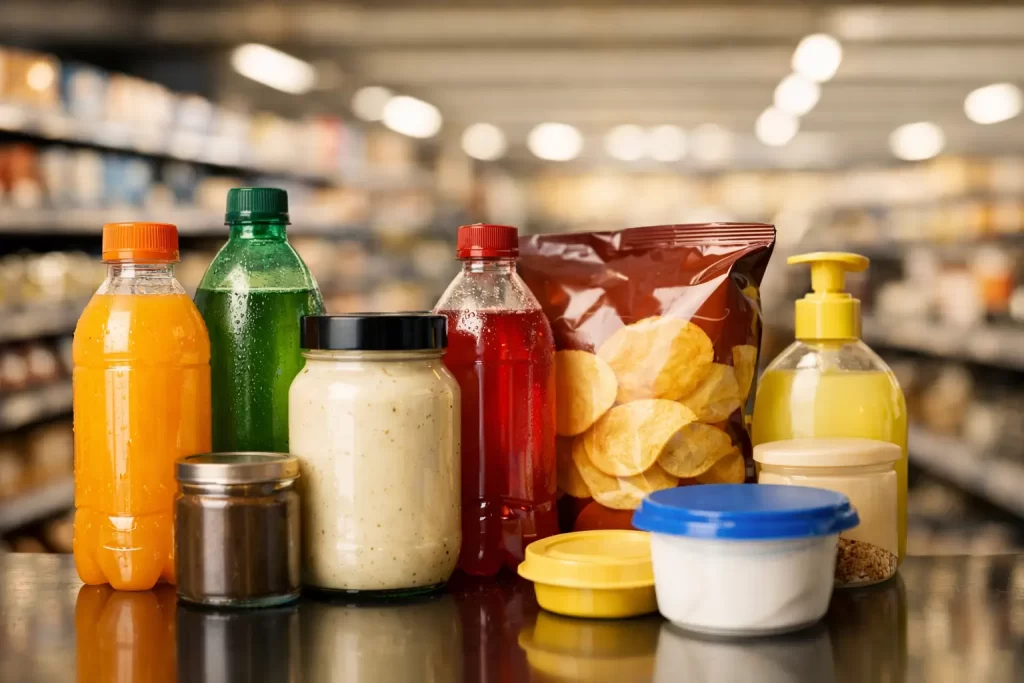
A product has seconds to earn attention, and in crowded retail categories, those seconds are expensive. That is why FMCG labels carry more responsibility than many teams initially account for. They are not just a printed surface. They are a working part of the pack that supports brand recognition, regulatory clarity, production efficiency, and product integrity at scale.
For procurement teams, brand managers, and packaging leaders, the challenge is rarely about getting a label printed. The real question is whether the label will keep performing across filling lines, distribution, retail handling, and consumer use. In fast-moving consumer goods, small label failures create outsized operational costs. Misalignment, poor adhesion, unreadable codes, color inconsistency, or material mismatch can affect sell-through, compliance, and rework rates in one cycle.
What makes FMCG labels different
FMCG packaging moves fast by definition. Volumes are high, replenishment cycles are short, and product lines often include multiple SKUs, formats, and promotional variations. Labels in this category need to work within that pace without slowing conversion or compromising presentation.
That creates a very specific set of demands. A label for personal care may need premium print impact and moisture resistance. A food label may need clear ingredient presentation, strong adhesion under chilled conditions, and consistent barcode readability. A home care product may need resistance to chemicals or frequent handling. In every case, the label has to support both the marketing function and the operational function.
This is where many buying decisions become more technical than they first appear. The lowest unit cost is not always the lowest total cost. If a label performs poorly on an automated line, lifts during transport, or varies across batches, the savings disappear quickly.
FMCG labels and the balance between branding and function
Strong shelf presence matters, but visual appeal alone does not define label quality. In FMCG, branding and function have to coexist without compromise.
A well-executed label communicates brand value through print sharpness, color consistency, finish, and tactile detail. At the same time, it must carry mandatory information clearly and remain legible under real retail conditions. That means typography choices, white space, substrate selection, and adhesive performance all need to be considered together rather than in isolation.
This is especially relevant when brand teams push for decorative effects while operations teams need speed and stability. Premium embellishments can elevate appearance, but they must still run reliably on the application line. Matte and gloss finishes, metallic effects, clear labels, shrink sleeves, and variable data can all add value, but only when specified with the packaging environment in mind.
The best outcomes usually come from treating the label as part of the packaging system, not as an artwork file waiting for print.
Material selection is where performance begins
When FMCG labels fail, the root cause is often material mismatch rather than print quality. Face stock, adhesive, liner, and finish all influence performance.
Paper labels can be cost-effective and visually strong for many dry applications, especially where premium texture or traditional shelf presentation is needed. Filmic materials are often the better choice when products face moisture, squeezing, abrasion, refrigeration, or curved containers. The decision depends on how the product is filled, stored, transported, displayed, and used.
Adhesive selection is equally critical. Containers made from glass, PET, HDPE, or flexible packaging surfaces do not behave the same way. Neither do cleanroom, chilled, humid, or high-speed labeling environments. A label that adheres well in one setup may struggle in another. That is why application temperature, service temperature, and surface energy need to be part of the specification discussion early.
There is also a sustainability dimension. Lightweight constructions, recyclable-compatible materials, and smarter substrate choices can support environmental goals, but they still need to meet line performance and durability standards. Sustainable packaging decisions work best when they are engineered, not assumed.
Print consistency matters more than most teams expect
In high-volume consumer categories, brand consistency is measured pack by pack, not just campaign by campaign. If one production run looks noticeably different from the next, the issue is visible immediately on shelf.
Consistent reproduction of color, text, and graphics is not simply a branding preference. It affects retailer confidence, product recognition, and the perceived quality of the product itself. This becomes more complex when businesses manage multiple SKUs, seasonal packs, promotional overlays, or regional compliance variants.
Flexographic and digital printing each have strengths here. Flexographic printing is highly effective for long runs where repeatability and efficiency are essential. Digital printing can add speed and flexibility for shorter runs, versioning, and variable content. In practice, the right manufacturing partner will align print method to business need rather than forcing every label requirement into one process.
That decision affects lead times, cost efficiency, and change management. It also affects how quickly a business can adapt to market shifts without introducing quality inconsistency.
Compliance, traceability, and data accuracy
The shelf-facing side of FMCG labels gets most of the attention, but the operational side can be just as important. Labels often carry batch codes, barcodes, QR elements, date information, and product identifiers that support retail scanning, inventory control, and traceability.
If these elements are poorly printed, badly positioned, or incompatible with line systems, the issue moves beyond aesthetics. It becomes a supply chain problem. Failed scans can disrupt warehousing, slow receiving, and introduce avoidable friction into distribution.
For some product categories, there are added requirements around warning statements, usage instructions, multilingual content, or tamper evidence. These details demand precision in both artwork management and print execution. Accuracy matters because corrections after production are expensive and disruptive.
This is one reason experienced label manufacturers play a broader role than many buyers expect. They are not just converting designs into rolls. They are helping ensure that labels are fit for market, fit for machinery, and fit for regulated distribution.
Why application performance is a purchasing issue
A label may look excellent in a proof and still perform poorly in production. That gap is where many packaging problems begin.
Application speed, container shape, label size, dispensing accuracy, and environmental conditions all influence success on the line. Narrow tolerances become especially important in FMCG because even a small percentage of application failures scales into significant waste over large runs.
Procurement decisions therefore need to account for more than print price. They should consider roll construction, unwind consistency, adhesive behavior, machine compatibility, and quality controls across repeated orders. This is where a dependable manufacturing partner creates value. Consistency from batch to batch reduces downtime, limits rejects, and makes planning more predictable.
For businesses managing aggressive launch calendars or high-output production schedules, reliability often matters more than theoretical savings. A slightly cheaper label that creates stoppages is not a commercial win.
Choosing the right partner for FMCG labels
The right supplier should be able to discuss shelf appeal, but they should also be able to speak confidently about substrates, line performance, code readability, and production scale. In FMCG, those conversations belong together.
Look for a manufacturer with proven print capability, material knowledge, and quality discipline. Ask how they approach repeatability across SKUs and replenishment cycles. Ask how they validate label constructions for different pack types and storage conditions. Ask how they support version control when artwork changes frequently. These are practical indicators of whether the supplier can support long-term packaging performance rather than just short-term output.
For growing brands and established manufacturers alike, the goal is the same. You need labels that protect brand presentation while working reliably in production and distribution. That takes more than capacity. It takes process control, technical judgment, and responsiveness.
Kimoha approaches this need as a manufacturing partner, combining print technology, application knowledge, and quality-focused execution to support high-performance packaging programs across demanding sectors.
The real value of getting FMCG labels right
When labels are specified correctly, they do more than decorate packaging. They reduce risk, improve operational stability, support compliance, and strengthen shelf presence in one move. That is why label decisions deserve the same level of scrutiny as any other critical packaging component.
If your packaging line is under pressure to move faster, your brand team needs stronger visual impact, or your business is shifting toward smarter and more sustainable packaging, the label is often one of the most practical places to improve results. The smartest next step is not asking how to print faster. It is asking whether your current label construction is doing enough for the product it represents.