


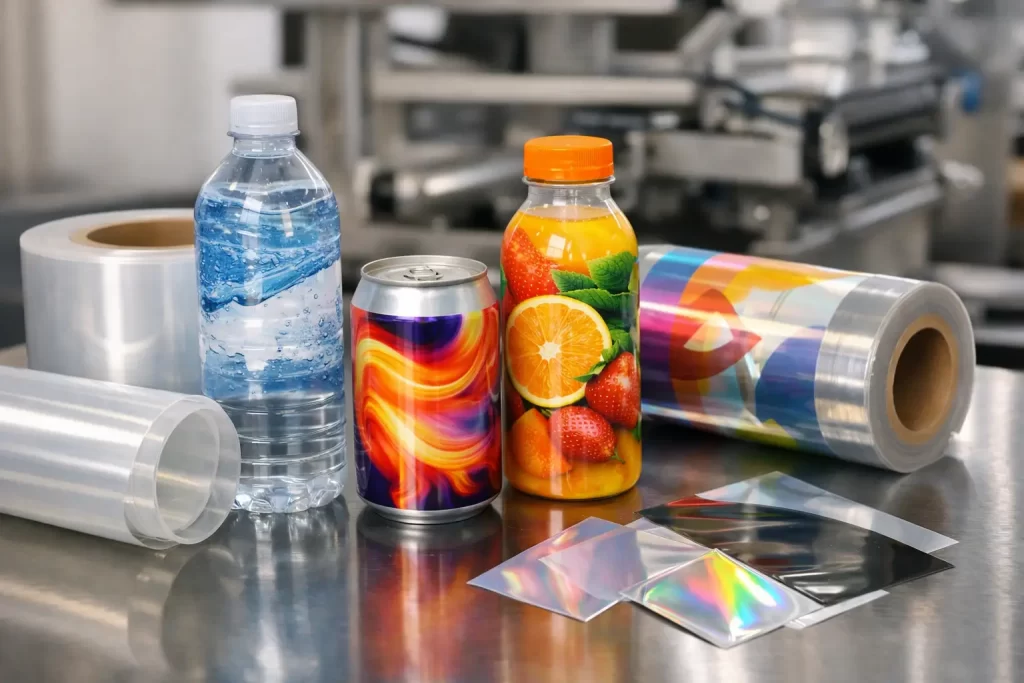
A premium print design can lose value fast if the shrink sleeve wrinkles at the shoulder, distorts key artwork, or fails on the line at production speed. That is why any practical guide to shrink sleeve materials needs to start with performance, not just appearance. For packaging teams, the right film choice affects decoration quality, machine efficiency, container compatibility, recyclability, and total delivered cost.
Shrink sleeves are not a single material category. They are a format built on different film structures, each with its own shrink behavior, clarity, stiffness, environmental profile, and converting demands. The material that performs well on a straight-wall beverage bottle may not be the best fit for a contoured home care container or a regulated healthcare pack.
Why shrink sleeve material selection matters
A shrink sleeve does more than carry graphics. It has to conform to the package shape, survive transport and storage conditions, and remain readable and attractive throughout the product lifecycle. If the material is poorly matched to the container, common issues follow – smile effect, trapped air, poor seam performance, warped barcodes, or uneven shrink around curves and handles.
Material selection also affects downstream operations. Sleeves must run reliably on high-speed application equipment and respond predictably in the shrink tunnel. Procurement teams often focus on unit price first, but the better measure is total packaging performance. A lower-cost film that increases waste or slows throughput can become the more expensive option very quickly.
Guide to shrink sleeve materials: the main film options
Most shrink sleeve projects center on four common materials: PETG, PVC, OPS, and PLA. Each can serve a specific packaging goal, but none is universally best.
PETG
PETG is widely used for premium shrink sleeve applications because it offers strong transparency, good gloss, and high shrink capability. It works especially well on containers with complex contours, where the sleeve must conform tightly without sacrificing visual impact. For brand owners that rely on 360-degree decoration, PETG gives designers more freedom.
Its high shrink percentage is a major advantage, but it also requires disciplined process control. Aggressive shrink can amplify artwork distortion if pre-press compensation is not handled correctly. PETG can also carry a higher material cost than some alternatives, so it is often chosen when container geometry or shelf appearance justifies the investment.
PVC
PVC has long been used in shrink sleeve packaging because it is cost-effective and processes easily in many applications. It offers consistent shrink behavior and can be a practical choice for standard container shapes and high-volume commercial runs. In cost-sensitive product categories, that predictability still matters.
The trade-off is that market demand has shifted in many sectors due to sustainability concerns and recycling compatibility considerations. For some brands and retailers, PVC is no longer the preferred path, especially where packaging strategy is moving toward more recyclable systems. It can still fit certain projects, but it is now evaluated more carefully than before.
OPS
OPS, or oriented polystyrene, is often selected when balanced shrink and material economics are priorities. It generally has lower density than PETG and PVC, which can help reduce material weight. It also offers good clarity and a relatively stable shrink profile for less demanding container shapes.
Where OPS becomes less ideal is on highly contoured packaging. Its shrink capability is usually lower than PETG, so it may struggle to conform cleanly to aggressive curves, deep recesses, or unusual bottle architecture. For straightforward formats, however, it can be a very efficient option.
PLA
PLA is often considered when sustainability goals are part of the packaging brief. Derived from renewable resources, it appeals to brands looking for alternative material stories and lower reliance on conventional petrochemical films. In the right program, that positioning can support broader environmental messaging.
That said, PLA is not a simple sustainability shortcut. Its performance depends heavily on storage, application conditions, and end-of-life infrastructure. It may not suit every high-speed or high-heat environment, and procurement teams should assess whether the market where the product is sold can realistically support the intended environmental claim.
How to choose the right shrink sleeve material
The best selection process starts with the container, not the film sample. Sleeve materials need to be matched to the shape, resin, filling conditions, and route to market.
Container shape and shrink requirement
If the package has dramatic contours, narrow waists, or molded grip features, high-shrink materials such as PETG are often the safer choice. They provide the conformity needed to avoid bridging and distortion. For simpler cylindrical or slightly tapered containers, OPS or PVC may deliver sufficient performance at a lower cost.
This is where many projects go off track. A material may look acceptable on a flat sample but behave very differently once exposed to heat around a three-dimensional form. Prototype testing on the actual container is essential.
Print quality and brand presentation
For products competing heavily on shelf, film clarity and gloss matter. Premium beverages, personal care products, and high-visibility consumer goods often benefit from films that support strong graphic reproduction and a polished finish. PETG is frequently selected in these cases because it supports vivid print presentation and demanding contours at the same time.
If the design relies on metallic effects, reverse printing, tamper-evident bands, or precise registration, material behavior during shrink becomes even more important. A strong print result depends on the full system – film, ink, adhesive seam, and tunnel conditions.
Line efficiency and converting stability
Packaging teams should also ask a practical question: how well will this material run? Some films are more forgiving during seaming, cutting, and application than others. A material that looks strong in concept may create issues with static, curl, seam integrity, or tunnel sensitivity on the production floor.
That is why converter experience matters. A dependable manufacturing partner will evaluate not only film specifications but also line speed, tunnel type, and container handling conditions before recommending a structure.
Sustainability and recycling goals
Sustainability is now part of material selection in most serious packaging reviews, but it needs to be addressed with precision. The right question is not simply whether a film sounds greener. The real issue is how the full pack performs within the target recycling stream and whether sleeve design supports removal, sorting, or compatibility requirements.
For example, a sustainable packaging strategy may involve lower-gauge films, floatable structures, wash-off systems, or design changes that improve recyclability rather than changing to a bio-based film alone. There is no one-size-fits-all answer. It depends on the package substrate, market regulations, and the recovery systems available.
Common trade-offs in shrink sleeve materials
Every material choice involves compromise. High shrink can solve difficult container geometry but increase distortion risk. Lower-cost films can help procurement targets but limit design flexibility or sustainability alignment. Lightweight options may reduce material use but require tighter process control.
This is why the right decision is usually cross-functional. Brand teams care about shelf impact. Operations care about uptime and waste. Procurement cares about delivered cost. Regulatory and sustainability teams care about compliance and recovery outcomes. The best shrink sleeve specification is the one that balances those priorities without creating avoidable production risk.
What business buyers should ask before approving a material
Before moving forward, teams should request shrink curves, gauge options, seam compatibility, distortion mapping, and machine trial data. It is also worth reviewing how the sleeve behaves under transport stress, warehouse temperatures, and final use conditions. A film that performs well in a controlled sample test may respond differently in regional distribution environments, especially for export-driven brands.
For companies managing multiple SKUs, standardization can also be valuable. Using one sleeve material across several pack formats may simplify procurement and inventory, but only if performance remains consistent across each container shape. Standardization without validation can create hidden quality costs.
An experienced supplier should be able to guide this discussion with application-specific recommendations rather than generic material claims. That is where industrial packaging expertise creates measurable value.
Guide to shrink sleeve materials for long-term packaging performance
The strongest shrink sleeve programs are built on testing, not assumptions. Material choice should reflect the container geometry, print objectives, operational realities, and sustainability direction of the brand. In many cases, the best answer is not the cheapest film or the highest-shrink film, but the one that performs reliably across the full packaging cycle.
For B2B buyers, that means treating shrink sleeve materials as a strategic packaging decision. The sleeve is visible to consumers, but its real value is often operational – protecting brand consistency, reducing line issues, and supporting packaging goals at scale. When the material is right, the decoration looks better, production runs smoother, and the package works harder for the brand.
The smartest next step is simple: test the material under real production conditions, because that is where good specifications become dependable packaging.
