


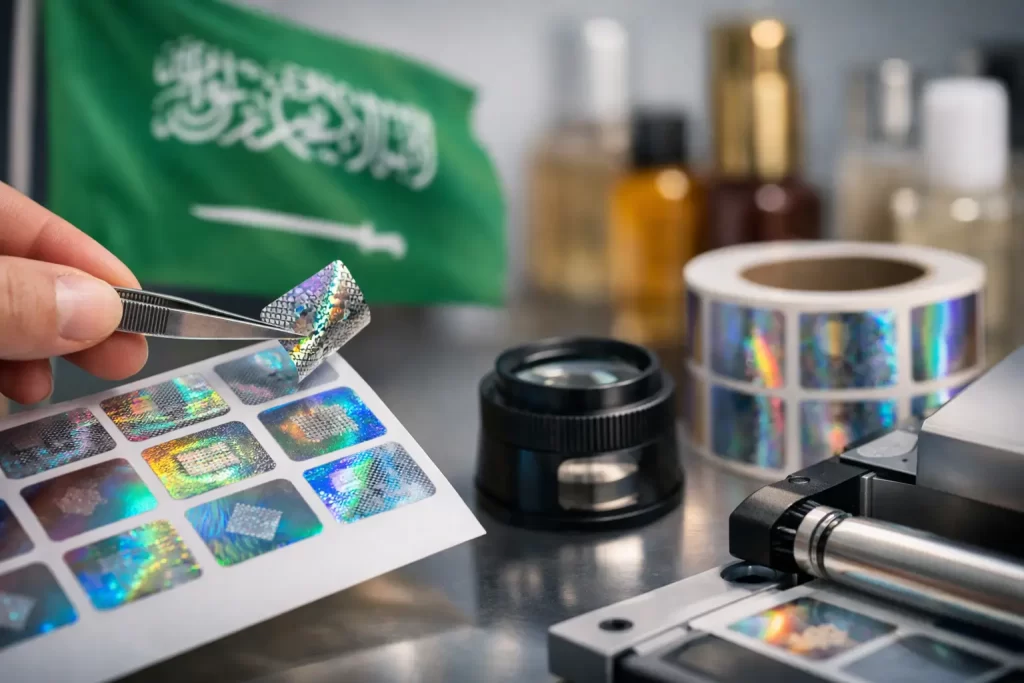
A damaged seal on a pharmaceutical carton, a relabeled lubricant drum, or a counterfeit personal care product on a retail shelf can create the same problem fast – loss of trust. That is why security label printing Saudi Arabia has become a practical priority for manufacturers, distributors, and brand owners that need more than a standard printed label. In many sectors, the label is now part of the product protection system itself.
For procurement teams and operations leaders, the real question is not whether security labels are useful. It is which type of security label fits the actual risk, production environment, and distribution model. A label that performs well on a folding carton may fail on textured plastic. A visible tamper seal may deter interference, while a covert feature may be better for authentication in the field. The right choice depends on what you are trying to prevent, detect, or track.
What security label printing in Saudi Arabia needs to solve
Security labels serve several business functions at once. They help show tampering, discourage product substitution, support traceability, and reinforce compliance in regulated categories. In fast-moving supply chains, they also reduce ambiguity. When a package, component, or shipment carries a clear security feature, warehouse teams, distributors, and end users can identify whether it has been opened, altered, or mishandled.
That matters across industries. Healthcare products may need evidence of first opening and lot-level identification. Automotive and industrial parts often require durable labels that stay readable through storage, transport, and handling. Retail and FMCG brands may need packaging protection that also preserves shelf appeal. Logistics applications may put more weight on serialization, barcode quality, and chain-of-custody visibility.
This is where printing capability matters. Security labels are not a single product category. They combine face materials, adhesives, print technologies, security features, and application conditions. A supplier should be able to align those variables with the operational reality of the product, not force a one-size-fits-all format.
The core types of security label printing Saudi Arabia buyers use
The most widely used format is the tamper-evident label. Once removed, it leaves behind evidence such as a destructible pattern, void message, or material breakage. This is often the best fit when the goal is immediate visual proof that the package or device has been opened.
For higher-value goods or brand-sensitive products, authentication labels add another layer. These may include serialized numbering, variable data, microtext, holographic elements, or covert print features that are harder to copy. Their value is strongest when authentication can be verified consistently by internal teams, channel partners, or field inspectors.
Some businesses now combine printed security features with digital identification. RFID-enabled labels, QR codes, and serialized barcodes can support verification, inventory control, and traceability at scale. This approach is useful when the label needs to do more than signal tampering. It becomes part of a larger product intelligence system.
The trade-off is straightforward. More advanced features generally improve protection, but they also affect cost, production setup, and verification workflows. If your distributors or inspectors cannot easily validate a feature, its practical value may be lower than expected.
Material and adhesive selection matter more than many buyers expect
A security feature is only as reliable as the construction behind it. Labels applied to glass, corrugated board, HDPE, PET, metal, or coated cartons all behave differently. Surface energy, temperature exposure, moisture, abrasion, and storage time can change performance significantly.
In security label printing Saudi Arabia, this becomes especially relevant for products moving through hot storage conditions, long-haul transport, or mixed warehouse environments. Adhesive failure, edge lift, poor scan performance, or print wear can compromise the purpose of the label. That is why material qualification and application testing are not optional steps for serious programs.
A durable topcoat, the correct adhesive chemistry, and the right print method can make the difference between a label that survives the supply chain and one that creates exceptions at receiving points. For industrial buyers, this is where manufacturing discipline shows.
How to choose the right security label program
The best starting point is the risk profile, not the artwork. Ask what event the label must reveal or prevent. Is the main concern package opening, counterfeit substitution, unauthorized returns, product diversion, or inventory leakage? Different risks require different label features.
Next, look at the application environment. Is labeling manual or automated? Is the product surface flat, curved, rough, or low-energy? Will the package be exposed to oils, refrigeration, sunlight, or rough handling? A label specified without these details may look acceptable in sampling but fail in production.
Then define the level of traceability required. Some operations only need visible tamper evidence. Others need unique serial numbers, linked batch data, or integration with scanning systems. If traceability is part of the objective, print quality consistency becomes critical. Poor barcode contrast or variable data alignment can weaken the entire system.
Buyers should also weigh aesthetic requirements. In retail packaging, the security label may need to support brand presentation, not disrupt it. That can influence material finish, print registration, and how visible the security feature should be on the final pack.
Production scale changes the right printing approach
Volume and version complexity often determine whether flexographic, digital, or hybrid production is the better fit. For stable, high-volume programs, flexographic printing can deliver strong consistency and cost efficiency. For shorter runs, frequent SKU changes, or high levels of variable data, digital printing offers more flexibility.
In many real-world projects, the right answer is a combination. A business may need brand graphics printed at scale, with security codes or serialized elements added through a variable process. The value of an experienced manufacturing partner is the ability to recommend the method based on the job, not just the machine.
Where security labels create the most value
In healthcare and pharmaceutical packaging, security labels help verify product integrity and support regulated distribution. In food and beverage, they can protect premium goods, imported products, and limited-release lines where tampering or imitation creates commercial risk. In logistics, they are useful for shipment closure, tote control, asset tracking, and exception management.
Aviation, automotive, and industrial supply chains often need labels that combine security with durability. Here, resistance to abrasion, chemicals, and handling is just as important as the anti-tamper feature. For consumer brands, the focus may shift toward balancing protection with strong on-shelf presentation.
What these sectors share is the cost of ambiguity. If a label cannot clearly signal authenticity, opening status, or product identity, the burden shifts to manual checks, customer disputes, and operational delays.
What to expect from a capable label manufacturing partner
Business buyers should expect more than print output. A capable supplier should ask about substrates, line speeds, storage conditions, compliance expectations, and scan requirements. They should be able to guide construction choices, provide consistent print quality, and maintain production control from approval to delivery.
Quality assurance is especially important in security work because minor inconsistencies can create major downstream issues. Registration accuracy, adhesive consistency, variable data control, and inspection standards all affect final performance. If the label includes authentication or traceability features, process discipline becomes even more important.
This is also where regional manufacturing support can add value. For companies operating across Saudi Arabia and the wider GCC, dependable supply, repeatability, and technical responsiveness matter just as much as label design. Kimoha supports enterprise buyers with industrial label manufacturing capabilities built around precision, customization, and long-term reliability.
Security labels are rarely a standalone purchase. They sit at the intersection of packaging, compliance, brand protection, and operations. The strongest results come when the label is specified as part of the full packaging and supply chain context, with testing, material selection, and production quality treated as business-critical decisions. If your product carries value, regulatory exposure, or brand risk, the label should do more than identify it – it should actively protect it.
The smartest security label programs start with a simple mindset: make tampering obvious, make verification practical, and make performance consistent every time the product moves.
