
















A rejected shipment, a disputed return, or a compromised medical carton usually comes down to one question: was this package opened before it reached the right hands? Tamper evident security stickers answer that question fast. For manufacturers, distributors, and brand owners, they do more than seal a pack – they create visible proof of interference, strengthen chain-of-custody control, and reduce uncertainty where product integrity matters most.
What tamper evident security stickers actually do
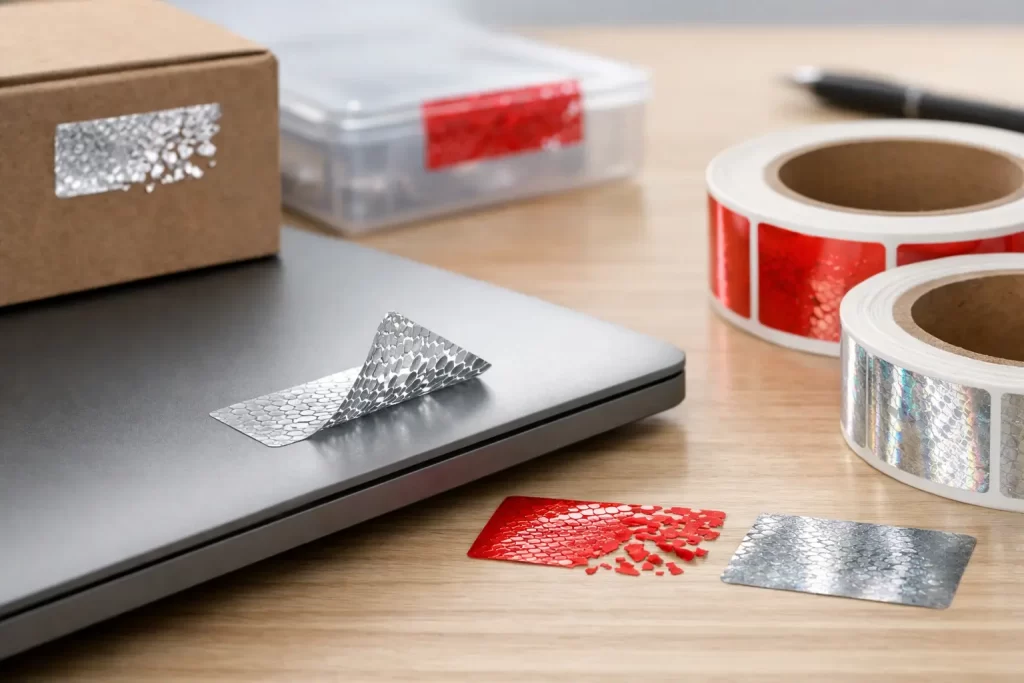
Tamper evident security stickers are designed to show clear signs when someone tries to remove, lift, or alter them. Unlike standard labels, they are built to leave evidence behind. That evidence may appear as a hidden message, a destructible face stock that breaks apart, a residue pattern on the surface, or a combination of visual and material changes that cannot be reset once disturbed.
That distinction matters in commercial environments. A standard closure label may keep a flap shut. A tamper evident construction helps prove whether the closure remained intact from packing to receipt. In sectors where accountability, safety, or authenticity is under scrutiny, that difference is operationally significant.
For procurement and operations teams, the value is practical. These labels help reduce claims disputes, support inspection workflows, deter casual tampering, and make unauthorized access harder to conceal. They also give frontline teams a simple visual checkpoint that does not depend on specialized equipment.
Where tamper evident security stickers add the most value
The right application depends on the risk being managed. In pharmaceuticals and healthcare, the priority is often product integrity and patient safety. In logistics, it may be shipment verification and transfer accountability. In retail and consumer goods, the concern may be package interference, product substitution, or counterfeit activity.
Product packaging and cartons
Applied across carton openings, folding boxes, pouches, lids, or secondary packs, these labels indicate whether packaging was opened after packing. This is especially useful for high-value consumer goods, cosmetics, electronics accessories, nutraceuticals, and regulated packaged products.
Shipping cases and logistics handling
For warehouse and transport operations, tamper evident labels help mark cartons, pallets, and transit containers that should remain sealed until final delivery or authorized inspection. They create a visible control point at handoff stages where responsibility changes from one party to another.
Asset protection and service control
Tamper evident constructions are also used on devices, panels, warranty points, and service-access areas. In these cases, the goal is not consumer presentation but control over unauthorized opening, field servicing, or internal component access.
Documents, kits, and evidence-sensitive materials
Some businesses use security labels on envelopes, kits, confidential files, and specimen packs where proof of opening is more important than decorative branding. In these uses, clarity and reliability matter more than shelf appeal.
Not all tamper evident labels perform the same way
This is where buying decisions often go wrong. Many teams treat tamper evidence as a simple feature, but performance depends on material construction, adhesive behavior, application surface, storage conditions, and the type of tampering expected.
A destructible vinyl label, for example, may work well on smooth durable surfaces where removal should cause fragmentation. A void label may be better where a hidden message must remain on the substrate after lifting. A seal used on corrugated board has different adhesion demands than one applied to glass, HDPE, coated paperboard, or metal.
Temperature also changes performance. Cold chain conditions, hot-fill environments, warehouse heat, and export transit can all affect how aggressively an adhesive bonds and how clearly a security feature reveals interference. If the label is too aggressive, it may damage the pack unnecessarily. If it is too weak, it may lift during normal handling and trigger false concerns.
That is why the best specification starts with the application, not the artwork.
How to choose tamper evident security stickers for your operation
The most effective selection process is grounded in risk and use case. Start with what you need the label to prove. Are you trying to deter opening, reveal opening, protect a warranty point, or support compliance documentation? Those are related goals, but they do not always require the same construction.
Next, consider the surface. A label applied to coated cartons behaves differently from one used on plastic jars or metal housings. Surface energy, texture, and cleanliness all influence bond strength and reveal quality. Then look at the environmental path: storage, filling line conditions, transport, and end use. Exposure to moisture, abrasion, freezing, UV, or chemicals may require a more specialized construction.
Print requirements are another factor. Some tamper evident labels only need a warning message or serial number. Others must carry barcodes, variable data, branding elements, or traceability information. When security and identification need to work together, print clarity becomes part of the specification.
Finally, think about application method. High-speed automatic application places different demands on release liners, dispensing consistency, and label format than manual hand application. A label that performs well in testing but slows a production line is not the right commercial answer.
Customization matters more than many buyers expect
Off-the-shelf security seals can work for low-risk uses, but many industrial applications need more control. Custom tamper evident security stickers can be designed around pack geometry, required adhesion, reveal pattern, and traceability needs.
Customization also improves process fit. A security label may need a particular size to bridge a tuck flap correctly, a certain adhesive to suit recycled board, or variable numbering to support internal audits. In some categories, adding brand colors or print identifiers helps staff quickly distinguish authentic seals from imitation replacements.
There is a balance to strike. Higher customization usually improves fit and control, but it can increase qualification time and specification complexity. For businesses managing multiple SKUs, sites, or export markets, standardizing a family of approved constructions is often more practical than specifying every label from scratch.
Why manufacturing quality is as important as the security feature
A security label is only effective if it performs consistently across production runs. In real operations, inconsistency creates cost. Labels that dispense poorly can interrupt lines. Adhesive variation can lead to field failures. Weak print registration can compromise variable data and inspection accuracy.
This is why converting quality, adhesive control, and print precision matter as much as the tamper feature itself. Security labels are not just design items. They are production components. Procurement teams should evaluate them the same way they would assess any other packaging material tied to compliance, brand protection, or operational risk.
A capable manufacturing partner should be able to discuss substrate compatibility, reveal technology, print method, application conditions, and validation testing in practical terms. That conversation is usually more valuable than broad claims about security performance.
Tamper evidence works best as part of a broader control strategy
Tamper evident labels are highly useful, but they are not a standalone answer to every security problem. They show interference. They do not physically prevent every form of access, nor do they replace serialization, track-and-trace systems, controlled packaging processes, or receiving inspections.
For many businesses, the strongest approach combines visible tamper evidence with other identifiers such as barcodes, variable codes, RFID-enabled systems, batch information, or inspection records. That layered model improves both deterrence and accountability.
It also helps internal teams respond faster. If a seal appears disturbed, traceability data can help identify where the issue occurred, which lots may be affected, and what containment action is required. The label becomes one part of a smarter packaging control system rather than an isolated accessory.
A practical standard for buyers and brand owners
If you are sourcing tamper evident security stickers, the right question is not simply which label is most secure. The better question is which construction gives clear, reliable evidence under your actual operating conditions without disrupting production, brand presentation, or downstream handling.
That means testing on real substrates, under real storage conditions, with real application methods. It means choosing a supplier that understands industrial labeling as a performance system, not just a printed product. Companies such as Kimoha support this kind of evaluation by aligning material selection, print capability, and application fit around the realities of enterprise packaging.
When tamper evidence is specified well, it brings something every operation values: clarity. And in packaging, logistics, and regulated supply chains, clarity is often what protects trust before a problem grows into a claim, a recall, or a damaged customer relationship.