
















A product can look perfectly legitimate on the shelf and still create serious risk for the brand behind it. Counterfeiting, tampering, unauthorized resale, and weak traceability rarely begin as obvious failures. They usually start in small gaps – a package that can be opened without evidence, a label that is easy to copy, or a supply chain that lacks product-level verification.
That is where security labels for products move from optional packaging detail to business-critical control. For procurement teams, packaging managers, and brand owners, the right label is not just a printed identifier. It is a functional layer of protection that helps preserve product integrity, brand trust, and operational visibility.
Why security labels for products matter
Security labeling sits at the intersection of packaging, compliance, and risk management. In sectors such as healthcare, food and beverage, retail, logistics, automotive, and consumer goods, a label may need to do several jobs at once. It may need to show tamper evidence, carry serialized data, resist transfer, support authentication, and still present the brand clearly.
This is why security labels should not be treated as a generic add-on. A low-cost label that fails under transport conditions or can be removed cleanly may create greater downstream cost than it saves upfront. Product recalls, rejected shipments, brand damage, and customer claims are far more expensive than specifying the right construction from the beginning.
For many businesses, the real value is deterrence. A visible security feature can discourage interference before it happens. In other cases, the value is forensic – helping teams identify where a breach occurred, whether a product was altered, or whether inventory moved through an unauthorized channel.
What makes a label a security label
Not every durable label is a security label. The difference is intent and design. Security labels for products are engineered to reveal, resist, or record unauthorized handling.
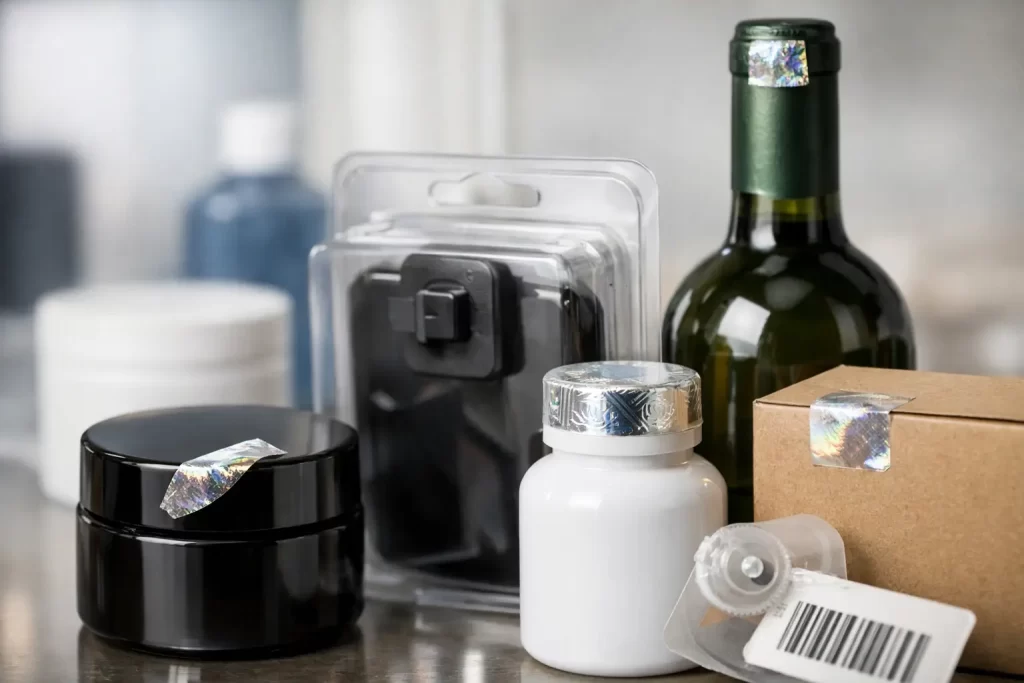
A tamper-evident label, for example, is designed to leave visible evidence when someone tries to remove or open it. This can appear as a destructible face stock, a void message, residue transfer, or a seal that fractures on removal. An authentication-focused label may use holographic effects, variable data printing, microtext, covert features, or serialized coding. A traceability-focused label may integrate barcodes, QR codes, or RFID to support item-level monitoring through the supply chain.
In practice, many industrial buyers need a combination of these functions. A pharmaceutical carton may need tamper evidence and serialization. A high-value electronics package may need warranty protection and anti-diversion tracking. A logistics application may prioritize chain-of-custody visibility over shelf appeal.
Different risks require different label constructions
The most common mistake in label selection is assuming one security format works for every product line. It depends on the product, the channel, the environment, and the kind of risk being addressed.
If tampering is the main concern, destructible films and void labels are often strong candidates. These make it difficult to remove the label intact and provide immediate visual evidence of interference. They are widely used on cartons, containers, closures, and electronics.
If counterfeiting is the greater threat, authentication features become more relevant. Overt elements help inspectors, retailers, or customers identify legitimate goods quickly. Covert elements support deeper verification for internal teams or enforcement partners. In some cases, serialized numbering adds another layer by making each label unique rather than repeatable.
If supply chain visibility is the priority, smart labeling can add significant value. RFID-enabled labels, for instance, can support faster inventory counting, movement tracking, and verification at scale. That approach is especially useful where manual scanning creates bottlenecks or where product movement must be documented with greater precision.
Material, adhesive, and print quality decide real-world performance
A security concept is only as strong as its execution on the production floor and in the field. Label performance depends on more than the visible feature. Face material, adhesive choice, print method, surface compatibility, and application conditions all affect the outcome.
A label applied to corrugated board behaves differently from one applied to glass, HDPE, metal, or a textured coated carton. Temperature exposure matters. So do humidity, abrasion, chemical contact, cold-chain conditions, and transport stress. A label that performs well in warehouse storage may fail on a product exposed to refrigeration, oils, or repeated handling.
Adhesive selection is especially important. If the adhesive is too aggressive for the substrate, it may damage the pack or create application issues. If it is too weak, the label may lift at edges or remove too cleanly. For tamper-evident applications, that balance must be engineered carefully.
Print quality also plays a direct role in security. Variable data must remain readable. Fine text and registration-dependent features need consistent reproduction. This is where manufacturing discipline matters. Advanced flexographic and digital capabilities are not simply production advantages – they help ensure that security features perform consistently across volumes, versions, and repeat orders.
Security labels and compliance often overlap
In regulated sectors, security labeling is not only about brand protection. It may also support compliance and audit readiness. Healthcare products, chemicals, aviation components, and some food categories often require traceable identification and clear evidence of package integrity.
That does not mean every regulated product needs the same solution. Some applications require highly visible tamper evidence. Others need durable identification that survives handling and storage. Still others require serialized or machine-readable information for inspection, recalls, or distribution control.
For packaging and compliance teams, the smarter approach is to define the operational requirement first. Is the label meant to prevent silent access, support authentication, improve recall response, or all three? Once that is clear, material and print decisions become far more precise.
Where buyers should be careful
Security labels can solve real problems, but they are not magic. If the rest of the packaging system is weak, even a well-designed label has limits. A carton seal may show tampering, but it will not stop diversion if the product itself lacks traceable coding. A serialized label may support verification, but only if the business has a process to capture and manage that data.
There is also a trade-off between visibility and complexity. Highly visible security elements may deter interference, but they can affect package design or increase unit cost. More advanced features can improve control, though they may require scanner compatibility, data infrastructure, or training across operations teams.
This is why the best security labeling programs are built around actual use cases, not broad assumptions. A premium cosmetic product sold through retail may need a different balance than an industrial spare part moving through regional distribution. Both need protection, but not necessarily in the same format.
How to choose security labels for products
For most business buyers, selection starts with four questions. What risk are you trying to reduce? Where in the supply chain does that risk show up? What surfaces and conditions must the label withstand? And how will success be measured?
Those questions quickly narrow the options. If success means visible proof of opening, tamper-evident constructions should lead the discussion. If success means identifying legitimate units within a broad distribution network, serialized or RFID-enabled formats may be more useful. If success means protecting both brand image and operational control, a hybrid approach often makes more sense.
Supplier capability should also be assessed carefully. Security labels are not just about supplying rolls at scale. They require converting precision, print consistency, substrate knowledge, and application understanding. A manufacturing partner should be able to advise on construction, test against real conditions, and maintain repeatable quality across production runs.
That is particularly important for brands operating across multiple SKUs, packaging formats, or regional distribution environments. Standardization where possible helps control procurement complexity, but over-standardization can create performance gaps. The right partner helps balance both.
Security labeling is becoming part of smarter packaging strategy
As supply chains become more data-driven, security labels are increasingly expected to do more than show evidence of interference. They are becoming part of broader packaging systems that support visibility, authentication, and product intelligence.
This shift is especially relevant for enterprise brands that need packaging to serve both operational and commercial goals. A label should protect the product, but it should also integrate with production speed, scanner systems, warehouse processes, and brand presentation. When those elements are aligned, security stops being a reactive feature and becomes part of packaging design strategy.
For companies reviewing their packaging mix, this is a good time to look closely at whether current labels are truly fit for risk, channel, and scale. Businesses that need dependable, application-specific security labeling often benefit from working with experienced manufacturers such as Kimoha, where material selection, print precision, and industrial use-case knowledge are treated as part of the solution rather than afterthoughts.
The best security label is the one that works quietly every day – protecting product integrity, supporting traceability, and giving your team one less vulnerability to worry about.