















A missed batch code rarely stays a small issue. It can slow recalls, create compliance gaps, confuse warehouse teams, and weaken confidence in your supply chain data. For manufacturers and brand owners asking how to improve packaging traceability, the answer usually starts with one fact: traceability is only as strong as the label, code, and data structure behind every pack.
Packaging traceability is not just about identifying a finished product at dispatch. It is about maintaining a reliable chain of information from raw material intake through production, packing, storage, shipping, and, when needed, market withdrawal. If any point in that chain relies on inconsistent labels, poor print quality, disconnected systems, or manual workarounds, traceability becomes slower and less dependable exactly when precision matters most.
How to improve packaging traceability at the packaging level
Many businesses treat traceability as a software problem first. In practice, packaging often determines whether the system works on the plant floor. A code that cannot be scanned consistently, a label that fails in cold chain storage, or a substrate that does not hold print clarity under transport stress can break the data trail long before ERP or WMS systems have a chance to help.
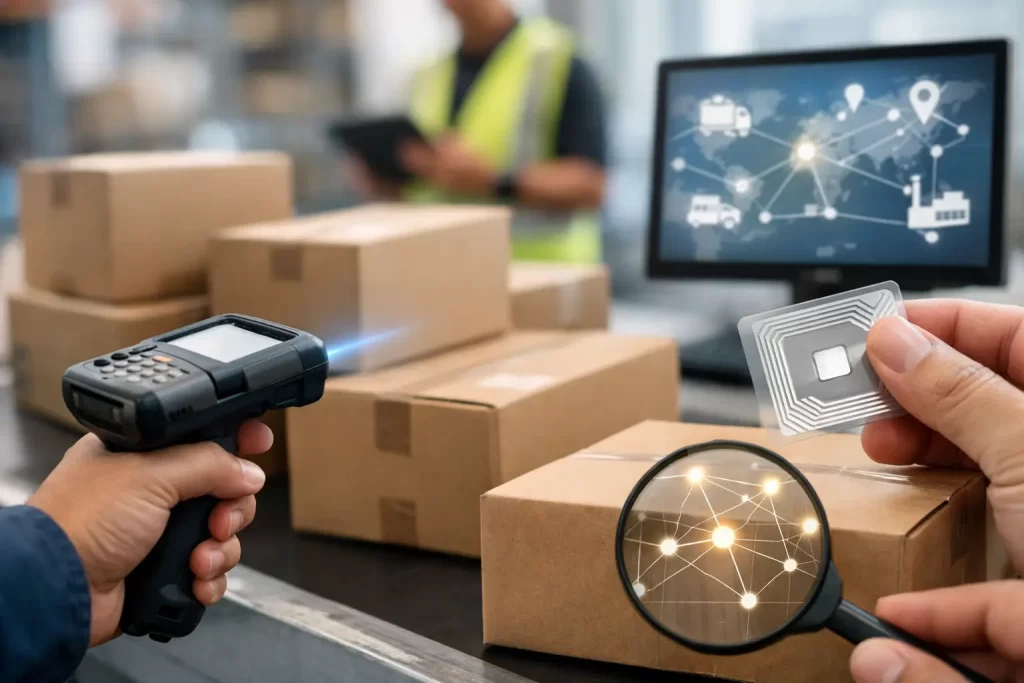
That is why packaging design, label construction, and print performance deserve early attention. A traceability program works better when the physical packaging is built for readable identification across the product journey. In food and beverage, that may mean moisture-resistant labels and high-contrast variable data. In healthcare, it often means tighter control over serialization, tamper evidence, and legibility. In logistics-heavy operations, it may mean durable barcodes or RFID-enabled labels that support faster movement through warehouses and distribution points.
The practical point is simple: do not separate traceability goals from packaging specifications. They should be developed together.
Start with a clear traceability architecture
Before changing labels or adding new technology, define what you need to trace, at what unit level, and for what business purpose. Some operations need pallet and carton traceability. Others need item-level identification because of regulatory exposure, recall risk, or channel complexity. The right answer depends on product category, margin profile, compliance requirements, and how often products are repacked or relabeled.
A clear architecture should answer four questions. What is being identified? Where is the identifier applied? Who captures it? Which system stores and validates it? If those answers vary by plant, line, or supplier without a good reason, the operation usually ends up with avoidable blind spots.
This is also where standardization matters. If one facility uses one barcode format, another uses a different data structure, and a third relies on manual batch notation, reporting becomes difficult and error rates rise. Standardized data fields, print rules, and scan protocols create a stronger foundation than adding technology on top of inconsistency.
Match the code to the use case
Not every packaging environment needs the same identification method. Linear barcodes remain practical for many secondary and tertiary packaging applications because they are widely accepted and cost-effective. QR codes and 2D data matrices offer more data density and can be better for smaller formats or more complex product information. RFID adds speed and non-line-of-sight reading, but it also requires a stronger business case and process readiness.
The trade-off is not just cost. It is also about reading conditions, throughput, integration requirements, and how much information needs to travel with the pack. A fast-moving warehouse may gain real value from RFID. A lower-volume operation with strict batch control may get excellent results from high-quality printed barcodes and disciplined scanning routines.
Improve print quality and label performance
One of the fastest ways to strengthen traceability is to reduce failures at the point of identification. That means improving how labels are produced, applied, and verified.
Variable data must remain sharp and readable throughout the supply chain. That sounds obvious, but many failures come from poor contrast, ink spread, smudging, substrate mismatch, or adhesives that do not suit the application environment. Heat, condensation, abrasion, and chemical exposure can all degrade readability. When that happens, operators often compensate with manual entry, and manual entry is where traceability accuracy starts to decline.
A better approach is to specify labels and packaging materials based on the actual conditions they will face. Frozen products, pharmaceutical packs, industrial containers, and retail-ready cartons all place different demands on print and adhesion. The packaging component should be engineered for those conditions, not selected only on unit cost.
Inline print inspection also makes a measurable difference. Verifying code presence, readability, and placement during production is more efficient than discovering failures in the warehouse or after shipment. The sooner an error is caught, the lower the cost of correction.
Connect packaging data to operations
Traceability improves when packaging identifiers are captured automatically at critical control points. That usually includes receiving, line-side issuance, packing, palletization, warehousing, and dispatch. The more consistently those handoffs are recorded, the easier it becomes to trace forward and backward without delay.
This is where many businesses face a gap between packaging and systems. The label may contain the right information, but if scanners, printers, MES, ERP, and warehouse systems are not aligned, the data trail remains fragmented. Solving that requires cross-functional ownership. Packaging, production, IT, quality, and supply chain teams need the same structure for product codes, batch records, and event capture.
If you are looking at how to improve packaging traceability across multiple SKUs or sites, focus on a few control points first rather than trying to digitize every movement at once. A phased rollout often performs better because it exposes process weaknesses early. Once label standards and scan discipline are stable, broader integration becomes far easier.
When RFID makes sense
RFID can significantly improve packaging traceability in environments where speed, automation, or bulk reading matter. It can reduce manual scanning effort, improve inventory visibility, and support better movement tracking through storage and distribution. It is particularly useful where products move quickly, labor pressure is high, or pack volumes make line-of-sight scanning inefficient.
Still, RFID is not a cure-all. Tag placement, read zones, material interference, and software integration all need to be planned carefully. For some businesses, RFID delivers strong returns. For others, upgraded barcode labeling and better data discipline solve most of the problem at a lower cost. The right decision depends on operational complexity, not just technology interest.
Strengthen supplier and packaging line controls
Traceability is often weakened by variation coming from outside the core production line. Pre-printed packaging from multiple suppliers, inconsistent batch marking practices, and manual relabeling can all introduce risk. If packaging components arrive without consistent identification or quality validation, the traceability chain is already compromised before filling begins.
Supplier specifications should define more than artwork approval. They should cover code placement, print tolerances, material performance, and verification requirements. The same standard should apply to contract packers and third-party logistics partners where relevant. A traceability system only works if each contributor supports the same identification logic.
Line changeovers are another common failure point. Wrong label application, code mismatch, and incomplete data resets happen most often during SKU transitions. Standard operating procedures, verification checkpoints, and operator training reduce those risks considerably. This is not glamorous work, but it has a direct impact on recall readiness and inventory accuracy.
Build for compliance, recalls, and trust
The best traceability systems do more than satisfy audits. They help businesses isolate issues faster, reduce the scope of recalls, and protect brand credibility when problems occur. That business value is often larger than the cost of implementation.
In regulated or high-risk categories, traceability also supports stronger proof of control. You can show what was packed, when it was packed, which materials were used, and where it was shipped. That level of visibility matters for internal quality reviews as much as for external compliance.
For companies balancing growth, speed, and product complexity, packaging traceability should be treated as an operational design choice, not an afterthought. The physical label, the data structure behind it, and the systems that capture it all need to work as one.
At Kimoha, we see this clearly across industrial labeling applications: when packaging is designed with traceability in mind from the start, businesses gain better control, faster decision-making, and fewer costly surprises. The strongest results come from improving the basics with discipline, then adding advanced tools where they create real operational value.
A traceable pack does more than carry a product. It carries accountability, and that becomes a competitive advantage when every shipment, scan, and batch record needs to stand up to scrutiny.