


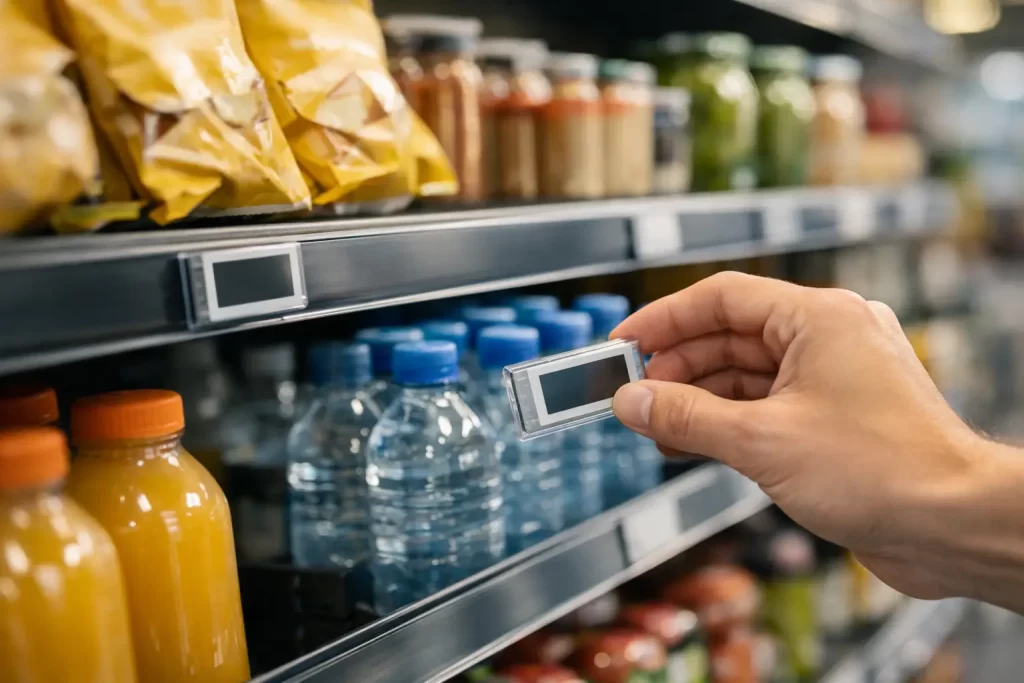
A pricing error at shelf level does more than create a small store-floor inconvenience. It slows checkout, frustrates customers, and puts pressure on store teams who are already managing replenishment, promotions, and compliance. That is why retail shelf edge labels matter far beyond simple price display. They are a working part of retail operations, brand presentation, and in many categories, regulatory clarity.
For retailers, brand owners, and procurement teams, the question is not whether shelf edge labels are necessary. The real question is what kind of label system will hold up under daily store conditions while supporting pricing accuracy, visual consistency, and efficient replacement cycles.
What retail shelf edge labels actually do
At a basic level, shelf edge labels communicate the product name, price, SKU, barcode, promotion, and sometimes pack size or unit pricing. In practice, their role is broader. They help connect the physical shelf to inventory systems, promotional calendars, planograms, and customer decision-making in real time.
That makes them a point-of-sale tool as much as an identification tool. A well-produced label supports clean shelf navigation and reduces doubt at the moment of purchase. A poor label, whether faded, misaligned, or difficult to scan, creates friction that can be felt across the aisle.
For high-volume retail environments, even a small failure rate becomes expensive. If labels curl, discolor, tear during replacement, or fail to stay legible under store lighting, the issue quickly turns into recurring labor and reprint costs. Over time, shelf edge labeling becomes an operational performance issue, not just a print specification.
Why material and print quality matter more than many buyers expect
Retail shelves are not controlled display cases. Labels face handling, temperature fluctuations, cleaning routines, overhead lighting, and constant product movement. Material choice has to reflect that reality.
Paper labels may be suitable for short-cycle promotions or fast-turn pricing updates where cost efficiency matters most. Synthetic materials are often a better fit where moisture resistance, abrasion resistance, or longer display life is required. In refrigerated or semi-humid retail zones, this difference becomes more visible very quickly.
Print quality is just as critical. Small text, dense pricing information, barcodes, and promotional color blocks need to stay sharp and readable. If print registration is inconsistent or the ink performance is weak, the label may still look acceptable at first glance but fail in practical use. That can affect scanning accuracy, shelf presentation, and consumer confidence.
For procurement teams, the trade-off usually comes down to lifecycle cost rather than unit cost alone. A cheaper label that needs frequent replacement is not always the lower-cost option once labor, waste, and store disruption are considered.
Retail shelf edge labels and store execution
Shelf execution depends on speed and consistency. Store teams need labels that fit fixtures correctly, apply cleanly, and can be replaced without damaging holders or creating visual clutter. In multi-store operations, standardization becomes especially valuable because inconsistency at shelf level can undermine central pricing and merchandising efforts.
This is where label construction matters. Dimensions must match shelf channels precisely. Adhesive performance must suit the application method and substrate. Variable data printing must remain accurate across batches, especially when stores are managing frequent promotions or region-specific assortments.
There is also a clear difference between labels designed for short promotional windows and those intended for longer shelf life. Temporary labels may prioritize fast printing and replacement ease. Permanent or semi-permanent formats may need stronger durability and more stable print performance. The right choice depends on how often pricing changes, how the shelf system is designed, and how much in-store labor is available.
The operational cost of poor shelf labeling
When buyers review shelf edge labels, they sometimes focus heavily on visible print output and unit pricing while underestimating the wider operational impact. That is a mistake.
An underperforming label can lead to pricing disputes at checkout, slower shelf audits, inaccurate replenishment checks, and extra labor spent replacing damaged labels. In categories with heavy promotional rotation, these issues multiply quickly. The result is a hidden cost structure that does not show up clearly on the original purchase order.
There is also a brand impact. Retail environments are judged visually. If the shelf edge looks inconsistent, outdated, or hard to read, customers may perceive the store as less organized and the brand as less dependable. That perception matters, particularly in competitive categories where purchase decisions are made in seconds.
Choosing the right retail shelf edge labels
The best specification starts with application reality, not generic assumptions. A convenience chain, a hypermarket, and a pharmacy retailer may all use shelf edge labels, but they do not need the same construction.
A useful evaluation should consider shelf type, replacement frequency, indoor environment, print data complexity, and expected label lifespan. If promotions change weekly, speed and variable printing flexibility may be priorities. If the label is expected to remain in place for extended periods, durability becomes more important. If scanning is part of the workflow, barcode performance must be tested under actual store conditions, not just approved on paper.
Color consistency can also matter more than expected, especially for promotional identifiers, category coding, or private label presentation. For large retail groups and consumer brands, shelf communication needs to align with wider visual standards. A manufacturing partner with strong print control can help maintain that consistency across volumes and locations.
Where customization adds real value
Not every retail environment benefits from highly customized shelf labels, but many do. Custom sizing, perforation, sequential numbering, variable data, and specialized adhesives can solve practical store-level problems that standard formats cannot.
For example, some retailers need labels that integrate with automated print-and-apply systems, while others need manually replaceable formats for smaller store networks. Some require multi-language output or unit pricing formats to meet market expectations and category rules. Others want branded promotional labels that carry stronger visual impact without compromising scan clarity.
This is where an experienced manufacturer becomes more than a supplier. The value is in translating store requirements, merchandising goals, and production constraints into a label format that works reliably at scale.
Print technology and production scale
Retail shelf edge labels often involve a mix of repeat consistency and variable data complexity. That means production capability matters. Flexographic printing can be highly effective for large-volume standardized runs where color consistency and efficiency are key. Digital printing brings advantages for shorter runs, versioning, and rapid promotional updates.
For many buyers, the right production setup is not one or the other. It depends on the label program. A manufacturer with both capabilities can align the process to the job rather than forcing the job into a limited production model.
Scale matters as well. Retail programs are rarely static. Product ranges expand, seasonal promotions increase demand, and rollout schedules tighten. Buyers need confidence that a label partner can maintain quality while meeting volume and timing requirements. Reliability in production planning is just as important as print quality on the finished label.
Sustainability is now part of the shelf label conversation
Sustainability goals are influencing more packaging and labeling decisions, and shelf edge labels are part of that shift. The right approach depends on the retailer’s operational model and waste reduction priorities.
In some cases, this means selecting materials that reduce unnecessary replacement frequency. In others, it may involve substrate choices, liner optimization, or print processes designed to support broader environmental objectives. The most practical sustainability decisions are the ones that improve performance as well as reduce waste. If a more durable label cuts replacement rates significantly, it can support both cost control and sustainability targets.
That is why shelf label procurement should not be isolated from wider packaging and in-store materials strategy. The better view is to treat it as part of a connected retail execution system.
What business buyers should expect from a label partner
A capable label manufacturer should offer more than production capacity. Buyers should expect material guidance, print accuracy, application-fit recommendations, and dependable quality control. In retail, small tolerances matter. A slight size variation or print inconsistency can create store-level issues across hundreds of locations.
This is especially relevant for businesses managing multiple SKUs, ongoing promotions, or regionally distributed operations. A partner with industrial print expertise and application knowledge can reduce risk before the labels ever reach a store. For enterprise buyers, that kind of predictability is often worth more than a low initial quote.
Kimoha supports businesses that need this level of precision, combining custom label manufacturing with production discipline shaped by high-volume commercial use cases across demanding sectors.
Retail shelf edge labels are easy to overlook because they appear simple. In reality, they sit at the intersection of pricing accuracy, shopper communication, operational efficiency, and brand presentation. When the specification is right, they quietly support store performance every day. When it is wrong, the cost shows up everywhere else.
