


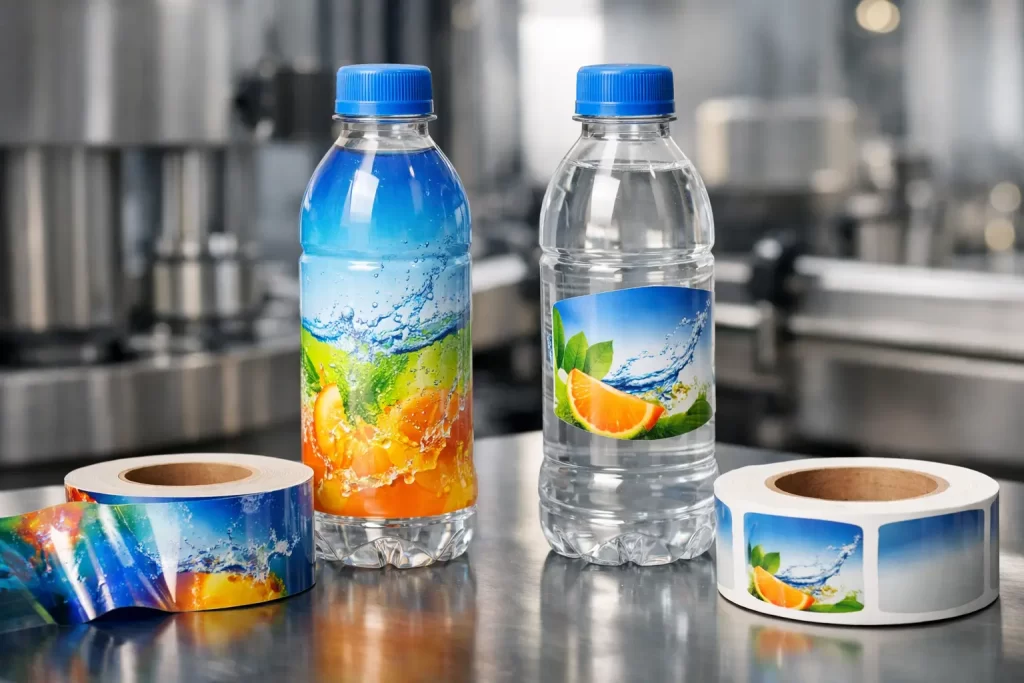
A packaging line can absorb a surprising amount of inefficiency from the wrong label choice. What looks like a simple branding decision often affects application speed, container compatibility, durability, compliance, and total unit economics. That is why shrink sleeves vs pressure sensitive labels is not a cosmetic comparison. It is a production and brand performance decision.
For procurement teams, packaging managers, and brand owners, the right answer depends on how the product needs to look, run, ship, and perform in market. Both formats are proven. Both can deliver strong results. But they solve different problems, and the trade-offs matter.
Shrink sleeves vs pressure sensitive labels: the core difference
Shrink sleeves are printed films that are applied over a container and then shrunk with heat to conform to its shape. Because they wrap around the full body, they offer near-360-degree decoration and work especially well on contoured bottles, jars, and specialty packs.
Pressure sensitive labels are self-adhesive labels applied directly to the package surface. They are supplied on a liner and dispensed by labeling equipment onto containers with pressure-based adhesion. They are widely used across food, beverage, home care, healthcare, logistics, and retail because they are efficient, versatile, and compatible with many production environments.
The first format delivers maximum visual coverage and shape adaptability. The second delivers application simplicity, broad material options, and efficient integration into many existing packaging lines. When teams compare shrink sleeves vs pressure sensitive labels, the decision usually comes down to brand impact, operational requirements, and budget discipline.
When shrink sleeves make more sense
Shrink sleeves are often the stronger choice when shelf presence is a priority. If your product needs high visual impact from every angle, a full-body sleeve creates more printable real estate than a front-and-back label setup. This can be valuable for crowded FMCG categories where packaging needs to carry branding, product information, regulatory text, and promotional content without looking overloaded.
They are also a strong fit for complex container geometry. Curved, tapered, or uniquely shaped bottles can be difficult for standard labels, especially if the design needs to stay visually aligned. A shrink sleeve conforms to the package after heat application, which allows decoration across shapes that would otherwise limit label placement.
Another advantage is tamper evidence. In sectors where product integrity matters, sleeves can extend over the cap or closure to provide visible tamper indication. This is particularly useful in beverage, personal care, and certain healthcare applications.
That said, shrink sleeves place more demands on process control. Film behavior, shrink ratios, seam quality, heat tunnel settings, and container material all need to work together. If those variables are not managed well, distortion can affect graphics and barcode readability. This is why the sleeve itself is only part of the decision. The converting quality and application environment matter just as much.
Where pressure sensitive labels have the edge
Pressure sensitive labels are often the practical choice when speed, flexibility, and cost control are high priorities. They are straightforward to apply, easy to integrate into automated lines, and available in a wide range of facestocks, adhesives, finishes, and constructions.
For brands managing multiple SKUs, short runs, or frequent design updates, pressure sensitive labels can offer more agility. They support variable information, promotional changes, and versioning without requiring a full-body packaging redesign. In operations where lead time, line simplicity, and inventory management are constant concerns, that flexibility can be significant.
They also work well when only part of the container needs decoration. If the package already has a strong structural presence, or if branding is concentrated on one or two panels, a pressure sensitive label may achieve the desired look with a lower material footprint and less process complexity.
In industrial and regulated environments, they are also highly adaptable. From durable logistics labels to product ID labels with compliance text, serialized information, or specialty adhesives, pressure sensitive constructions can be engineered around performance requirements rather than visual coverage alone.
Cost is rarely just the label price
Many label decisions go off track because teams compare only unit label cost. That is too narrow. The real comparison includes material, line efficiency, waste, changeover time, storage, transportation, rework risk, and the commercial value of shelf presentation.
Shrink sleeves may carry higher overall system complexity, especially if the packaging line requires steam or heat tunnel capability and tighter application controls. But in some categories, the branding effect can justify that investment. A premium beverage or personal care product may gain enough shelf differentiation from full-body graphics to offset the added production cost.
Pressure sensitive labels are often more economical from an application and equipment standpoint, particularly for straightforward container shapes and high-efficiency lines. They can reduce operational burden while still supporting strong print quality and finish options such as matte, gloss, metallic effects, tactile coatings, or clear-on-clear label aesthetics.
The better question is not which format is cheaper. It is which format creates the best total value for the product, channel, and production model.
Container shape and substrate compatibility
Container design plays a major role in this decision. Straight-walled containers are generally very label-friendly and can perform well with pressure sensitive formats. If the surface is smooth, consistent, and offers enough panel area, pressure sensitive labeling is often efficient and reliable.
As the container becomes more contoured, tapered, or unconventional, shrink sleeves become more attractive. They can decorate surfaces that would challenge adhesive labels, especially where wrinkle control and visual continuity are important.
The package material also matters. Plastic, glass, and metal containers each respond differently in application environments. Adhesion performance, moisture exposure, cold-fill or hot-fill conditions, and end-use handling should all be reviewed before choosing a format. A label that looks excellent in approval samples can still fail if the adhesive, film, or application method is not aligned with the actual use case.
Sustainability considerations are evolving
Sustainability is now part of the specification process, not a side discussion. Both shrink sleeves and pressure sensitive labels can support sustainability goals, but neither should be treated as automatically better in every case.
Shrink sleeves can reduce the need for pre-decorated containers and support strong design flexibility, but recyclability depends on the film structure, sleeve design, and how the package moves through recycling streams. Pressure sensitive labels can also be engineered with sustainability in mind through material selection, liner optimization, and adhesive choices, yet recyclability still depends on the full packaging system.
This is where technical guidance becomes essential. The label should be evaluated as part of the container, not as an isolated component. For brands moving toward more sustainable packaging, the right manufacturing partner helps align visual goals, line performance, and recovery considerations early in development.
Print quality, compliance, and brand execution
Both formats can deliver high-quality graphics, but the design process is different. Shrink sleeves require artwork planning around distortion, shrink direction, and seam placement. Pressure sensitive labels demand precise adhesive and material selection, especially when the label must hold up to refrigeration, abrasion, chemicals, or outdoor exposure.
Compliance content also changes the equation. If a product needs ingredient panels, multilingual information, variable coding, traceability data, or anti-counterfeiting features, available print area and production method become important. A full-body sleeve can carry extensive information cleanly. A pressure sensitive label may be better when variable data integration and production efficiency are more important than complete coverage.
For many enterprise brands, this is where an experienced converter adds real value. It is not just about printing a label. It is about matching print technology, material construction, and converting precision to the realities of the product and market.
How to choose the right option
If your product depends on standout shelf appeal, uses a complex container shape, or benefits from tamper-evident presentation, shrink sleeves are often the stronger fit. If your operation values speed, flexibility, established application efficiency, and targeted labeling on simpler package geometries, pressure sensitive labels may be the better business decision.
There are also cases where brands use both. A company might use shrink sleeves for flagship consumer packaging and pressure sensitive labels for secondary formats, promotional runs, or operational labels elsewhere in the product system. The right choice does not need to be ideological. It needs to be commercially sound.
At Kimoha, packaging discussions are most productive when they start with application realities rather than assumptions. Container shape, run speed, environmental conditions, compliance needs, and brand objectives all deserve equal weight.
The best label format is the one that keeps your line moving, protects your brand presentation, and performs exactly as expected when the product reaches the shelf.
