














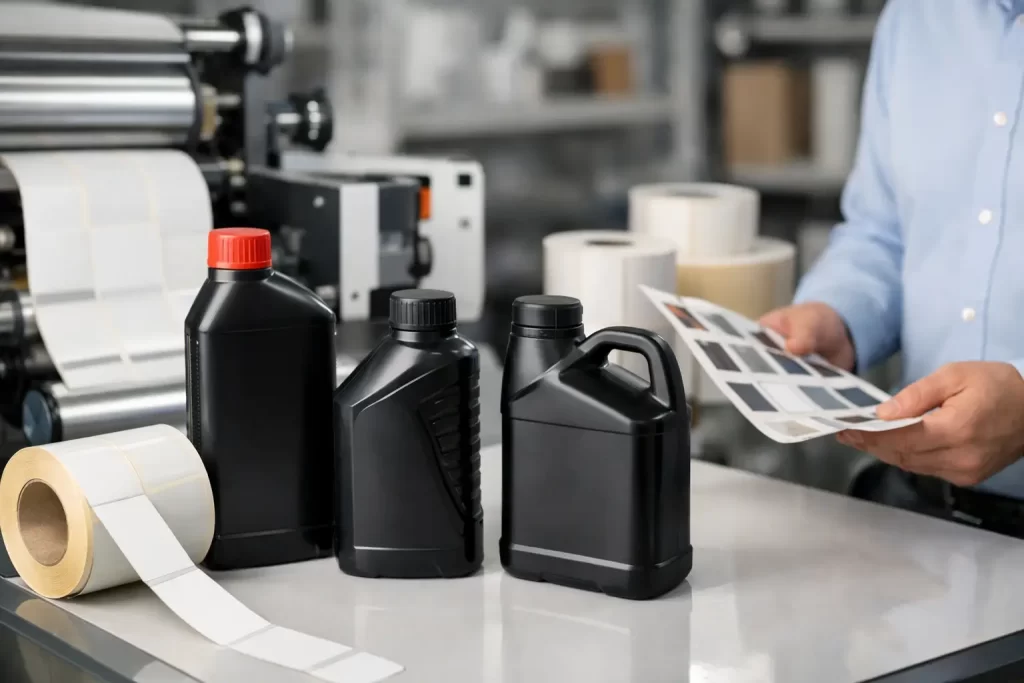
A lubricant bottle sits in punishing conditions long before it reaches the end user. It may be exposed to oil splashes, warehouse dust, changing temperatures, rough handling, and long storage cycles. That is why choosing a lubricant bottle labels supplier is not a routine print-buying decision. It is a packaging performance decision that affects brand visibility, compliance, and line efficiency at the same time.
For procurement teams and packaging managers, the label has to do more than look sharp on the shelf. It must stay bonded to curved containers, resist smudging, carry variable product information accurately, and remain readable through transport and use. When any of those elements fail, the cost goes beyond reprints. It can lead to returns, production delays, or avoidable questions from distributors and customers.
What a lubricant bottle labels supplier must deliver
Lubricant packaging creates a different set of demands than many standard consumer labels. Bottles are often made from HDPE or similar plastics with surface characteristics that can challenge adhesion. Product lines may include engine oil, hydraulic fluids, gear oils, greases, and industrial lubricants, each with different pack sizes, storage conditions, and regulatory requirements.
A capable supplier understands these conditions at the material level. That means recommending facestocks, adhesives, laminates, and print technologies based on actual end use rather than default specifications. A label that performs well on a dry carton in retail may not perform well on a slightly textured lubricant bottle stored in high heat.
Print quality matters just as much. Lubricant labels often carry dense content such as viscosity grades, technical approvals, handling instructions, barcodes, batch data, and multilingual copy. Fine text and small icons need to remain crisp, especially when packaging formats are compact. If registration drifts or text fills in, compliance and readability can suffer fast.
Why material and adhesive choice matter more than design alone
Brand teams naturally focus on graphics, color consistency, and shelf impact. Those are valid priorities. In the lubricant segment, though, performance starts with construction.
The face material needs to withstand abrasion and contact with oils or chemicals. Depending on the application, filmic materials can be a better fit than paper because they offer stronger moisture resistance and durability. Laminates or varnishes may also be necessary where labels face scuffing in transit or repeated handling in workshops and industrial environments.
Adhesive selection is where many packaging issues either get solved early or become expensive later. Bottles may be filled at different temperatures, labeled at high line speeds, and stored in warm or dusty conditions. Some products move through export chains with large climate variation. A supplier with real technical depth will test adhesive performance against the bottle substrate and operating conditions rather than assuming one construction works across every SKU.
There is also a trade-off to consider. A high-performance construction can improve durability, but it may raise unit cost. That does not always mean it is the wrong choice. If the label prevents line stoppages, field failures, and relabeling, the broader cost picture often favors the more reliable specification.
Evaluating a lubricant bottle labels supplier for production fit
A supplier can produce attractive samples and still struggle in live production. For B2B buyers, the more useful question is whether the supplier can support repeatable output at your required scale.
That starts with print process capability. Flexographic printing is often the right fit for larger production runs where consistency, speed, and cost control are critical. Digital printing can add value for shorter runs, versioning, and frequent artwork changes. In many lubricant portfolios, both are useful. The right manufacturing partner should be able to align the printing method with your run length, change frequency, and approval process.
Capacity and lead time deserve close attention. If your product mix includes standard and seasonal SKUs, or if you manage multiple packaging formats across regions, your supplier needs disciplined scheduling and quality controls. Delays in label supply can disrupt filling lines just as easily as delays in bottles or caps.
Prepress accuracy is another area that separates dependable suppliers from average ones. Lubricant labels often include layered information, technical symbols, and regulatory text in limited space. Artwork management, version control, and proofing discipline reduce the risk of costly mismatches between approved files and printed output.
Compliance, traceability, and barcode performance
A lubricant label is a branding tool, but it is also an information carrier. For many manufacturers, traceability and compliance are non-negotiable.
Barcodes must scan reliably across warehousing and distribution environments. Variable data such as batch codes, manufacturing dates, or product identifiers must print clearly and remain legible over time. If labels are used across export markets, language requirements and product declarations may vary by region, which increases the need for structured artwork control and print precision.
This is where an experienced lubricant bottle labels supplier adds practical value. The goal is not just to print what is requested. The goal is to anticipate where readability, substrate choice, or finishing could affect compliance in the field. The more technical the product line, the more useful that consultative approach becomes.
Some manufacturers also need added layers of product authentication or supply chain intelligence. Depending on the use case, that can include security features or smart labeling elements that support track-and-trace programs. Not every lubricant brand needs those capabilities, but for premium products or wide distribution networks, they can be worth considering.
The role of brand consistency in a crowded market
Industrial and automotive buyers may be driven by product performance, but packaging still shapes trust. When lubricant labels show inconsistent color, weak adhesion, or poor finishing, the brand impression shifts immediately. That matters on retail shelves, in distributor networks, and in industrial supply environments where customers compare products side by side.
Consistency across SKUs is especially important for lubricant portfolios. Product families often rely on color coding, format hierarchy, and clean technical communication to help buyers quickly identify the right variant. If one line prints darker, another uses a different finish, and a third has misaligned application, the portfolio starts to look fragmented.
An experienced manufacturing partner protects that consistency through process controls, color management, and inspection standards. This is not just a design issue. It is a commercial issue, because packaging inconsistency can weaken confidence in the product behind it.
Questions worth asking before you commit
When assessing a lubricant bottle labels supplier, buyers should look beyond pricing and basic lead times. Ask how the supplier validates adhesion on your bottle material. Ask what print method they recommend for your expected run length and why. Ask how they manage artwork revisions across multiple SKUs and whether they can support future additions such as security features, RFID, or sustainability goals.
It is also worth asking about testing. Can they evaluate label performance under heat, handling, and chemical exposure relevant to your product environment? Can they maintain consistent quality across repeat orders, not just first production? Those answers reveal far more than a generic capability sheet.
For companies operating across the GCC, regional service capability can also matter. A supplier with established manufacturing discipline and dependable delivery support can reduce risk in multi-market packaging programs where timing and consistency are closely watched.
Why long-term supplier value beats short-term label cost
The lowest label price rarely tells the whole story. If labels fail in application, arrive with avoidable variation, or require repeated approval corrections, internal costs rise quickly. Operations teams feel it on the line. Procurement feels it in emergency reorders. Brand teams feel it when packaging quality slips.
A stronger supplier relationship usually creates value in quieter ways. Material recommendations become sharper. New SKU development moves faster. Quality issues are caught earlier. Packaging changes are easier to implement. That is the difference between a print vendor and a manufacturing partner.
For businesses that need industrial-grade performance, the right choice is a supplier that combines print quality, technical guidance, and production reliability. Companies such as Kimoha support this need by bringing together advanced label manufacturing, customization capability, and quality-driven execution for demanding packaging applications.
The best label programs tend to be the ones no one has to think about after launch. They run cleanly, hold up in the field, and support the product exactly as intended. That is what a good lubricant label should do, and it is what the right supplier should make routine.